


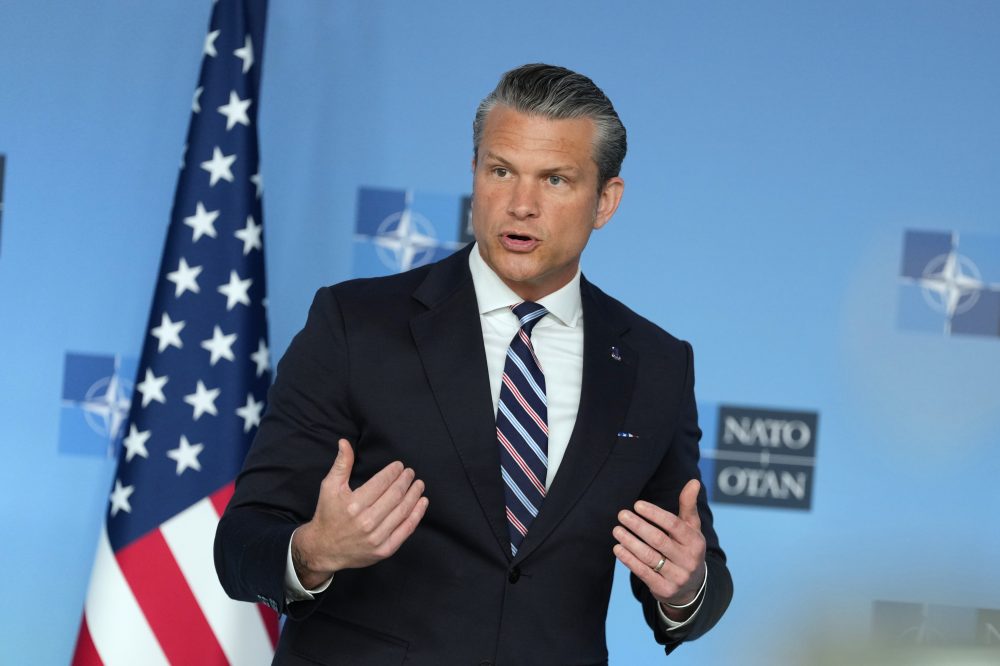
BRUSSELS (AP) – U.S. Defense Secretary Pete Hegseth said Thursday that America’s allies in Europe must take the lead on the defense of their own continent and help turn NATO into “a read hard-line military alliance.”
At a meeting of NATO defense ministers, Hegseth called for a reboot of the 32-nation organization to turn it into a “NATO 3.0” capable of deterring any threat.
His remarks came a few weeks after the United States told its allies that it would no longer supply certain warships and aircraft if one of them comes under attack. European allies and Canada are trying to work out how to plug the gaps.
“NATO 3.0 is post-Cold War recognition that (NATO) needs to go back to a real hard-line military alliance that has real military capabilities capable of deterring right here on the continent and taking the lead for the conventional defense of Europe,” Hegseth said.
As part of that, he told reporters, the United States would be investing $1.5 trillion in its own defense in 2027, sending “a message to the world” that America is building an “arsenal of freedom.”
Hegseth said that this arsenal “first and foremost protects America and American interests but also backstops the strength of NATO and our allies.”
He said he would tell U.S. allies they “have to be willing to stand up and do something in a strong way about” the defense of their own continent.
NATO’s supreme allied commander, an American, is working on backup plans to defend Europe after the U.S. signaled on June 3 that it would no longer supply an aircraft carrier and support ships, aerial refueling planes and dozens of fighter jets, among other military assets, in a crisis.
The Trump administration insists that it needs to be able to plan for two simultaneous conflicts and wants more military resources at hand should a conflict break out with China in the Indo-Pacific region.
Under NATO’s collective security guarantee – Article 5 of its founding treaty – the 32 allies pledge that an attack on one of them will be considered an attack on all. It does not oblige them to provide military support, although many likely would.
In essence, the United States is scaling back how it might help should an ally trigger Article 5. The U.S. has by far NATO’s biggest armed forces. It does not intend to withdraw its nuclear weapons in Europe, which are key to NATO’s deterrence.
Brought to you by www.srnnews.com