


By Andrew Chung
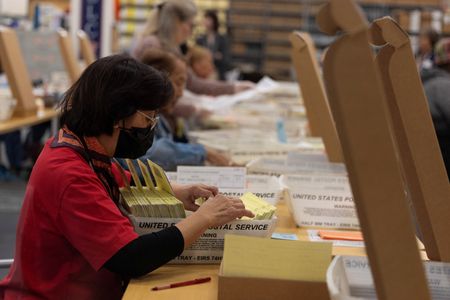
WASHINGTON, June 29 (Reuters) – The U.S. Supreme Court backed on Monday state laws that allow mail-in ballots received after Election Day to be counted, rejecting a Republican-led challenge to a five-day grace period in Mississippi and dealing a setback to President Donald Trump.
The justices in a 5-4 ruling overturned a lower court’s decision that had deemed Mississippi’s law inconsistent with U.S. statutes that set the timing of federal elections – for the presidency, Senate and House of Representatives. Trump last year vowed to end the use of mail-in ballots nationwide before this November’s congressional elections, when his fellow Republicans are seeking to retain control of Congress.
The court has a 6-3 conservative majority. Conservative Chief Justice John Roberts and fellow conservative Justice Amy Coney Barrett joined the court’s three liberals in the majority. Barrett wrote the opinion.
Conservative Justices Samuel Alito, Clarence Thomas, Neil Gorsuch and Brett Kavanaugh dissented from the decision.
Mississippi’s law permits mail-in ballots to be counted if they were postmarked on or before Election Day but received up to five business days after a federal election. Absentee voting by mail in Mississippi is limited to a few categories of voters including people age 65 and above, the disabled and those living away from home.
About 30 states and the District of Columbia accept at least some ballots that are postmarked on or before Election Day but received afterward.
The Republican National Committee, the Mississippi Republican Party and other plaintiffs filed a lawsuit in 2024 seeking to invalidate Mississippi’s law.
Trump’s administration backed the challenge. Restricting mail-in ballots would stand to disproportionately benefit Republicans given that Democratic voters traditionally have been more likely to use mail-in ballots than Republican voters.
After the ruling, Trump again called on Congress to pass the SAVE America Act, a partisan federal elections bill that would require photo identification to vote and proof of citizenship to register to vote. Republicans have been unable to overcome Democratic opposition in the U.S. Senate, where 60 votes are required to advance most legislation in the 100-seat chamber. Republicans hold a 53-47 Senate majority.
“In light of the tremendous loss in the Supreme Court today concerning Voter’s Rights, and the fact that ‘people’s’ votes are allowed to be counted LONG AFTER an Election is over, it is more important than ever to pass THE SAVE AMERICA ACT,” Trump wrote.
Trump added, “There is only one reason to oppose – CHEATING!”
Democrats have accused Trump of seeking measures that would make it harder for people to vote, especially groups that tend to favor Democratic candidates
A SKEPTICAL VIEW
Republicans have taken a skeptical view toward mail-in ballots. Trump has sought to cast doubt on the security of these ballots, although evidence of voter fraud is rare. Trump issued an executive order in March to restrict mail-in ballots nationwide, but a federal judge in Boston on June 25 blocked its implementation.
Trump has continued to make false claims of widespread voting fraud in the 2020 presidential election that he lost to Democrat Joe Biden.
During the first year of the COVID pandemic, the Republican-controlled Mississippi legislature in 2020 passed the law on mail-in voting on a bipartisan basis.
The New Orleans-based 5th U.S. Circuit Court of Appeals in 2024 ruled in favor of the Republican challengers. It declared that the measure was preempted by federal laws setting Election Day for federal elections as the “day by which ballots must be both cast by voters and received by state officials.”
Federal law “does not permit the state of Mississippi to extend the period for voting by one day, five days or 100 days,” the 5th Circuit stated.
The 5th Circuit did not immediately block Mississippi’s procedures, but instead sent the case back to a trial judge for further review. The litigation was placed on hold pending the Supreme Court’s consideration.
During Supreme Court arguments in the case in March, some of the conservative justices expressed concerns that permissive mail-in ballot practices could cause the appearance of voter fraud. Some of the liberal justices said the arguments made by the challengers also would jeopardize the widespread practice of early voting prior to Election Day.
Though the 5th Circuit’s action applied only in the three states where the regional federal appeals court has jurisdiction – Mississippi, Louisiana and Texas – it called into question the voting practices in the other states with similar mail-in ballot policies.
The 5th Circuit’s decision would “override countless state laws from the past 165 years and largely require citizens to vote in person, on Election Day, in their home districts, without the secret-ballot system,” Mississippi said in its appeal.
OTHER ELECTION-RELATED DECISIONS
Acting in other election-related cases, the Supreme Court’s conservative majority in April gutted a key provision of the Voting Rights Act, blocking an electoral map that had given Louisiana a second Black-majority U.S. congressional district.
The ruling makes it harder for minorities to challenge electoral maps as racially discriminatory under the 1965 civil rights law and represented a victory for Louisiana Republicans and Trump’s administration.
That decision prompted several Republican-led states to pursue redrawn electoral maps ahead of the midterms in an effort to put at risk U.S. House seats considered safely Democratic-held.
(Reporting by Andrew Chung; Additional reporting by Nolan McCaskill and Doina Chiacu; Editing by Will Dunham)
Brought to you by www.srnnews.com