
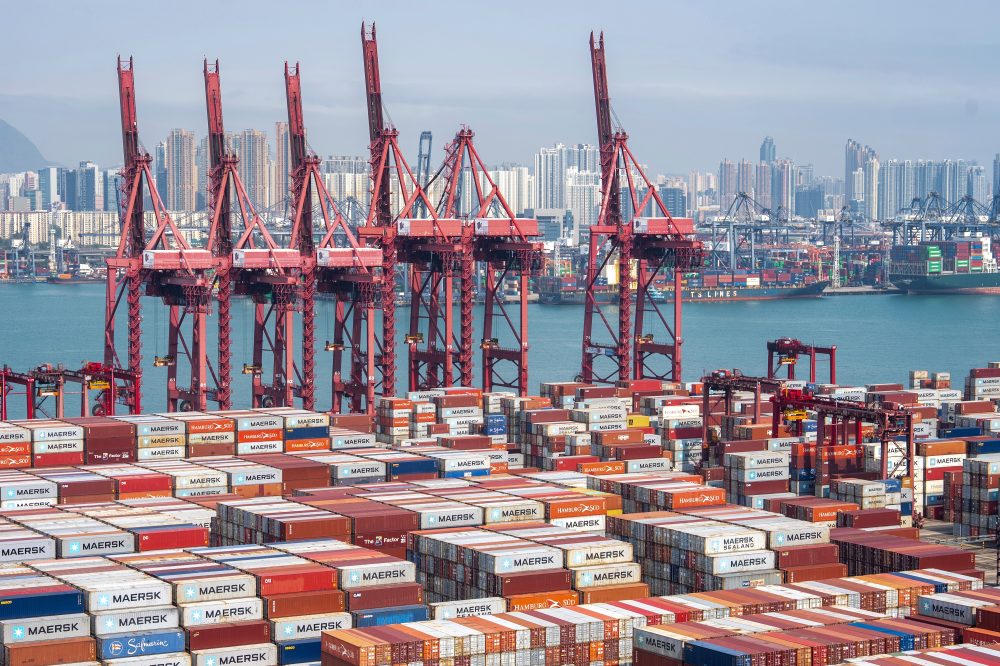
HONG KONG (AP) – The United States said Saturday it did not renew a national emergency declaration over Hong Kong, leading to the lifting of partial sanctions, but it said an executive order that revoked Hong Kong’s special trading status remains in place.
Hours ago, China said the U.S. recently confirmed to China that the President’s Executive Order on Hong Kong Normalization would end, the ministry said in a statement responding to media questions. That announcement had appeared to be a sign that the city’s preferential privileges might be restored.
But a statement from a State Department spokesperson sent to the AP said that U.S. President Donald Trump “allowed the national emergency to end, but Executive Order 13936 otherwise remains in effect.”
As the order states, Hong Kong is no longer sufficiently autonomous to justify differential treatment in relation to mainland China under certain laws and provisions, it said.
The U.S. Office of Foreign Assets Control said in a statement Friday that the national emergency declared in the executive order had expired and that it delisted people who were sanctioned under the order. But it said people who remain sanctioned under the Hong Kong Autonomy Act of 2020 have been added to a different sanction list.
The statement showed Hong Kong leader John Lee and his predecessor, Carrie Lam, were removed from the first list but added to the second one.
The declaration had significant overlap with the other act linked to Hong Kong, and 39 of the 48 people affected by the expiration would continue to be sanctioned under that act, according to a Treasury Department spokesperson who was not authorized to speak publicly on the issue by name and spoke on condition of anonymity.
“The non-renewal is consistent with sanctions modernization efforts that streamline sanctions for greater efficiency and effectiveness, including by ensuring our sanctions are not duplicative,” it said.
Trump signed the executive order in July 2020 in his first term in response to Beijing imposing a national security law.
China considers the law for Hong Kong necessary to restore stability in the city after massive anti-government protests in 2019. The pro-democracy movement back then posed one of the biggest challenges to the Communist Party in Beijing and the Hong Kong government since the former British colony returned to Chinese rule in 1997.
Under the order, it eliminated the preferential treatment for Hong Kong to the extent permitted by law and in the national security, foreign policy, and economic interest of the United States.
The full implications of the U.S. decision not to renew the declaration were not immediately clear. The White House referred questions about the executive order lapsing to the Treasury Department.
China’s Commerce Ministry said on Friday evening that the U.S. made commitments on Hong Kong issues and other matters during the U.S.-China trade talks in Madrid last year. It struck a positive tone in its statement.
“The U.S. side’s actions represent an important step in fulfilling the consensus reached during the bilateral economic and trade talks. China appreciates it,” it said.
The Hong Kong government said in a statement that it noted the “positive shift in the U.S. policy” toward the city.
“Safeguarding Hong Kong’s prosperity and stability serves the common interests of China and the U.S. and also aligns with the general expectation of the international community,” it said.
It said it hopes the U.S. will respect China’s sovereignty and the rule of law in Hong Kong and resume normal economic and trade exchanges with the city.
The U.S. policy change, which came two months after Trump met with his counterpart Xi Jinping in Beijing. It could be seen as another sign of warming ties between Beijing and Washington ahead of Xi’s expected visit to the U.S. later this year. Earlier this month, a pastor of a prominent underground church who was detained in China in October was released after Trump brought up his case with Xi.
But it is unclear whether the differences on how they understand the change could cast a shadow over that.
Six years after the national security law’s introduction, many leading activists, including pro-democracy former media tycoon Jimmy Lai, were imprisoned under it. Critics say the Western-style civil liberties that Beijing promised to maintain for 50 years after the handover have declined.
___
Associated Press writer Joshua Boak in Washington contributed to this report.
___
This story has been updated to correct the details of the U.S. decision. A previous version of the story said the United States confirmed it would not renew the executive order.
Brought to you by www.srnnews.com