

By Nathan Layne
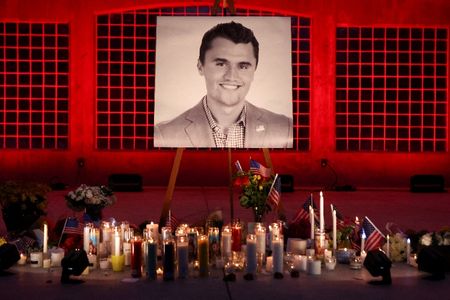
DALLAS, Sept 10 (Reuters) – One year after Charlie Kirk’s assassination, the organization he co-founded, Turning Point USA, has grown dramatically, expanding its presence at colleges and high schools and cementing itself as a force in Republican politics.
But some of the young voters Kirk helped bring into the party are not proving uniformly loyal to Republican President Donald Trump, testing the coalition that helped return him to the White House in 2024.
Kirk will be memorialized at the Republicans’ first-ever midterm convention on Thursday, exactly one year after he was killed, as the party confronts signs of slippage among young men, a key constituency that powered Trump’s victory.
Kirk, 31, was fatally shot in the neck during a debate at Utah Valley University in Orem, Utah. Tyler Robinson has been charged with killing him, and a Utah judge ruled last week that prosecutors may seek the death penalty.
In the year since Kirk’s death, the movement he helped build has been buffeted by conspiracy theories about his assassination and by rising frustration among some young voters over the cost of living, the Iran war and records tied to convicted sex offender Jeffrey Epstein.
Josh Holstein, the 24-year-old chairman of the West Virginia Republican Party who first met Kirk while a high school student at a Turning Point training event, said any turmoil was temporary and pointed to the addition of dozens of Turning Point chapters across West Virginia since Kirk’s death.
“Obviously there’s going to be a reorganization if you have the unexpected death of somebody with that significant of a voice in the movement,” Holstein said, adding that he saw the memorial in Dallas as an opportunity to remind young voters “that what matters is the safety of our country, the future of our country and prosperity for young people.”
COST OF LIVING A FACTOR
Young voters’ concerns are focused largely on the cost of living. A Harvard Youth Poll, conducted in late March and early April, found that half of Americans ages 18 to 29 said inflation affected them “a lot,” while 45% said they were struggling to make ends meet or have little financial security.
They are also more opposed than any other age group to the Iran war, with just 16% saying it was the right decision, according to a recent YouGov/Economist poll.
That opposition reflects a broader strain of anti-interventionism among younger Republicans. Conservative media figures with large followings among young men, including Tucker Carlson, have amplified criticism of the war by arguing that U.S. policy toward Iran was shaped too heavily by Israeli interests.
Months before his death, Kirk warned Vice President JD Vance that many young conservatives believed Israel had too much sway over U.S. foreign policy and that, in some cases, criticism of Israel was crossing into antisemitism, according to a book Vance published in June.
“The rifts that are happening among younger conservatives and the party more broadly – Israel is a huge part of that,” said Nicole Hemmer, a history professor at Vanderbilt University who studies conservative politics. “There’s quite a lot of anger on that front with Trump, and there’s a lot of anger about the economy.”
DOWNWARD SWING IN POLLS
As a result, some young men have soured on Trump. Last month, some 32% of men aged 18 to 29 approved of the president’s performance in the White House, down from 43% in February 2025, according to Reuters/Ipsos polling. Trump garnered the support of 46% of young males in the 2024 election, up seven points from 2020, according to exit polling analyzed by Pew Research.
Andrew Kolvet, a spokesperson for Turning Point, said Kirk had watched frustration among young voters build last year over the administration’s handling of the Epstein files and the strikes on Iran’s nuclear facilities, with persistent cost-of-living pressures deepening the discontent.
“Charlie saw these fault lines emerging and was messaging to it,” said Kolvet, a close friend of Kirk’s.
Despite those challenges, Turning Point’s growth has accelerated over the past year. The group now has more than 3,500 high school chapters nationwide, up 180%, and more than 1,500 college chapters, up more than 60%, Kolvet said.
“It’s happened amidst a broader political environment where there are obvious headwinds,” he said. “I think it’s a testament to his legacy and the team here.”
TURNING POINT ENDURES
Kyle Spencer, who chronicled Kirk’s rise in her book “Raising Them Right,” said the infrastructure he built at Turning Point, including a youth voter turnout operation, remains formidable and should not be underestimated. But she said the Trump administration’s campaign against what it calls woke culture, including diversity, equity and inclusion programs, has deprived young conservatives of a central adversary, dulling a key rallying point for them. Kirk, she added, would likely have been better equipped than his successors to navigate the shift.
“The really like positive, kind of all-encompassing buzz around TPUSA that was in existence for such a long time is kind of now competing with this new kid on the block,” she said, referring to a growing interest among some young voters in socialist and left-wing ideas. “The excitement right now is gravitating more towards progressive voices.”
Young voters could prove decisive in midterm elections in November.
A survey of 5,549 young adults conducted earlier this year by Tufts University’s Center for Information & Research on Civic Learning and Engagement found that 56% of respondents ages 18 to 29 were “extremely likely” to vote in the midterms, two points higher than in a comparable poll ahead of the 2024 presidential election, when turnout is typically higher.
That raises the stakes for Republicans as young voters grapple with persistent cost-of-living pressures.
Jack Posobiec, a conservative commentator who worked alongside Kirk at Turning Point, said this was the kind of moment made for Kirk, who excelled at meeting young people on their own terms.
“He would say: ‘What is driving your interest in socialism? … You can’t just browbeat young people. You have to listen to what they’re actually feeling, understand it,"” Posobiec told Reuters at the convention. “I think there is a disconnect in the Republican messaging when it comes to that.”
(Reporting by Nathan Layne; Editing by Michael Learmonth and Howard Goller)
Brought to you by www.srnnews.com