


By Andrea Shalal
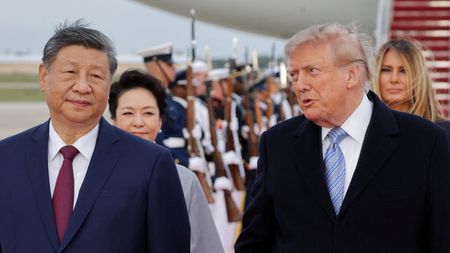
WASHINGTON, Nov 17 (Reuters) – US Democratic Senator Tammy Baldwin on Tuesday introduced legislation to revoke China’s normal trade status and favorable tariff treatment just days before US President Donald Trump and Chinese President Xi Jinping are due to meet for a third time this year to discuss a delicate trade truce.
Baldwin’s bill, which argues that Beijing had failed to uphold the principles of fair trade, would set a deadline to end the permanent normal trade relations that have been in effect since 2002 a year after the legislation is enacted.
The legislation, which could have more support under a Congress controlled by Democrats next year, would shift Chinese imports to higher regular US tariff rates under the Harmonized Tariff Schedule.
The existing US “Most Favored Nation” tariff rates for China and other countries average about 2.5%, but Trump has heaped punitive duties on Chinese imports, about 25% during his first term and up to 20% during his second term under a trade truce with Beijing.
Baldwin’s bill also would direct the US Trade Representative’s office to issue a report together with the Commerce Department and US International Trade Commission and other bodies on ongoing trade and economic challenges posed by China.
Lawmakers have repeatedly sought to revoke China’s special treatment in recent years, but the bills have failed due to competing economic priorities, legislative bottlenecks, and shifting trade dynamics, with Republicans not challenging Trump’s tariff pressure. But there is growing anti-China sentiment in Congress, particularly among Democrats who won control of both the Senate and House of Representatives in elections this month.
Trump, who meets with Xi in Shenzhen, China, this week, could still veto the bill if it passes.
“We need to reset our trade relationship with China, be honest that they have undercut us at every turn, and put the focus back where it matters – prioritizing American workers, manufacturers and families,” said Baldwin, who voted against the change in China’s tariff treatment in 2000 while serving in the House of Representatives.
She said in a statement that the US had “rolled out the red carpet for China” for two decades while Beijing had engaged in market manipulation, intellectual property theft and other unfair trade practices, noting that the US-China Economic and Security Review Commission, an independent, bipartisan legislative agency, also recommended revoking the PNTR status of China in November 2024.
Western concerns about China’s efforts to dominate global markets have grown in recent years, fueled by Beijing’s threats to shut off exports of critical minerals needed for advanced manufacturing – and its actual moves to do so for Japan.
Trump, who ordered a review of China’s trade status when he took office in January 2025, and Xi are expected to discuss a fragile trade-war truce that will expire in January when they meet later this week amid growing tensions over trade. China’s foreign ministry has accused the US of “economic coercion” over its latest restrictions on Chinese access to advanced chips.
Baldwin’s office said there was “growing recognition that granting China PNTR failed to deliver the changes in China’s economic and trade practices that were promised,” and the bill would establish a more durable US trade policy.
Revoking China’s current trade status would increase the price of Chinese imports, especially for manufactured goods, and in the long run, raise US consumer prices by 0.7% and reduce US economic output by 0.2%, the US International Trade Commission said in a 319-page report released in August.
But two ITC commissioners – a Republican and a Democrat – challenged the notion that ending PNTR status for China would raise costs, arguing that the analysis failed to account for economic harm caused by granting it in the first place.
The ITC concluded that revoking PNTR would raise trade-weighted average tariffs by 35.2 percentage points.
(Reporting by Andrea Shalal; Editing by Andrea Ricci )
Brought to you by www.srnnews.com