


By Jiaxing Li and Rae Wee
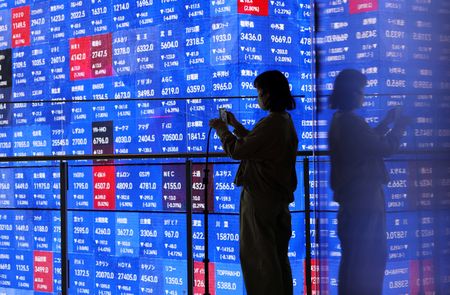
HONG KONG/SINGAPORE, Nov 20 (Reuters) – Asian shares fell on Friday, heading for their worst week since 2020, as Anthropic’s debut failed to restore investor faith in the AI sector, while the dollar extended a rally on safe-haven flows.
MSCI’s broadest index of Asia-Pacific shares outside Japan lost 3.2%, its biggest single-day drop in over a month. The gauge has now sunk 8.3% this week, its worst performance since March 2020.
Japan’s Nikkei tumbled 4.1% and was headed for a 6.8% weekly drop, while South Korea’s KOSPI fell 4.4% and was set to end the week 7.1% lower. Taiwan shares were down 5% on Friday and 16% for the week, their biggest weekly decline since 1991.
The moves in Asia followed losses of more than 2% for the S&P 500 and the Nasdaq Composite after Anthropic, the world’s first publicly traded frontier AI company, saw its shares surge in a historic debut but the euphoria failed to lift other stocks.
“Risk aversion intensified as investors continued to unwind crowded positioning and reassess the broader macro backdrop following Anthropic’s record-shattering IPO,” said Preston Pagli, markets analyst at Citi.
He added that Nvidia’s blowout earnings earlier in the week failed to become the reset markets had hoped for, while sentiment deteriorated further after Anthropic’s IPO failed to spark a broader rally.
Further adding to the unease, a report on AMD from a media outlet associated with short-selling fund Hunterbrook Capital raised concerns that the chipmaker’s ties to Chinese entities, some linked to blacklisted firms, could draw greater US regulatory scrutiny to the sector.
The AI trade has already been battered by Jensen Huang’s departure from Nvidia, growing momentum for the anti-data-centre movement following Democrats’ sweep of the US midterm elections, and concerns over the sector’s rising debt loads.
“No one headline drove the roll though some pointed to an AMD short report which tapered overall sentiment. Overall, it just felt like more questions than answers out there today with most wondering what gets this tape to feel better?” said Goldman Sachs analysts in a trading note.
They said asset managers and hedge funds net-sold macro products while they net-bought pockets of consumer and financials, with liquidity remaining poor, which is exacerbating price action.
US stock futures also pointed to further losses, with the S&P 500 futures down 0.2% and Nasdaq futures down 0.6% in Asia on Friday.
DOLLAR EXTENDS RALLY, TREASURY YIELDS DIP ON RISK AVERSION
As risk sentiment took a beating, the US dollar extended its rally on safe-haven bids, while also being supported by growing expectations of a more hawkish Federal Reserve.
Fed funds futures imply that a quarter-point rate hike next month is essentially locked in, according to CME Group’s FedWatch tool.
The dollar index last traded steady at 103.86, after rising to its highest since April 2025 this week, and is now on track to post its fourth week of gains.
In government debt, US Treasury yields eased as the sharp equity selloff pushed investors toward safe-haven bonds. The yield on benchmark 10-year Treasury notes held steady at 5.02%, near a one-week low. The 2-year yield touched 4.749%, compared with a US close of 4.779%.
Oil prices were mostly steady after an earlier spike, as reports of tanker disruptions in the Strait of Hormuz offset pressure from rising US crude inventories and forecasts for a global oil surplus.
Brent crude futures rose 0.4% to $92.37 a barrel but remained on track for a third week of declines.
Non-interest-bearing gold slid 2.5% to $3,533.40 an ounce and was headed for a 9% weekly loss.
(Reporting by Jiaxing Li in Hong Kong and Rae Wee in Singapore; Editing by Edwina Gibbs and Christian Schmollinger)
Brought to you by www.srnnews.com