


By Casey Hall and Sophie Yu
SHANGHAI, Nov 20 (Reuters) – A flurry of US measures targeting China’s access to advanced AI chips further pummelled Chinese technology stocks this week, as investors weigh whether Washington’s latest curbs will slow Beijing’s ambitions or accelerate its drive for technological self-sufficiency.
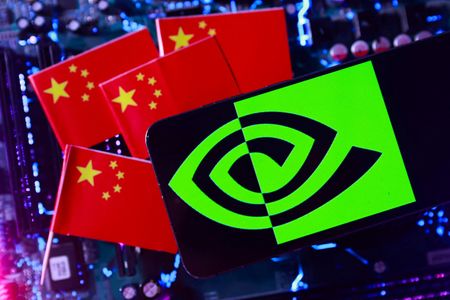
Chinese technology firms faced a series of new pressures, including US restrictions targeting Chinese firms’ remote access to advanced AI chips, Nvidia’s suspension of some chip shipments to China, a shareholder lawsuit against Alibaba and a US proposal that could require American companies to disclose their use of Chinese AI models.
Together, the developments show how the US-China contest for leadership in artificial intelligence is moving beyond semiconductor exports to cloud computing, software and corporate disclosure.
“Closing the gap at the leading edge before 2028, or even by 2030, looks difficult,” Neil Shah, vice president of research at Counterpoint Research, said of the impact of US measures on China’s AI industry.
The impact would be “far more prominent” in frontier model training than in inference, Shah said, adding that AI startups such as Moonshot AI, Z.AI, MiniMax and DeepSeek were more likely to be hit harder than hyperscalers such as Alibaba and Tencent.
Shares in leading Chinese tech companies have slumped since last week after Nvidia co-founder Jensen Huang, who has pushed to preserve access to the Chinese market, resigned as CEO following reports that he had extramarital affairs, including one with a suspected Chinese spy.
Z.AI has tumbled 22% and MiniMax 34% over the last two weeks.
NEAR-TERM HIT
As Washington tightens curbs on access to advanced computing power, Chinese companies are racing to build a domestic AI ecosystem less dependent on US technology.
Executives at Tencent and Alibaba, two of China’s biggest AI companies, said during earnings calls this week that the latest US restrictions would tighten computing constraints, though they differed on the near-term impact.
Tencent said its cloud business would be largely unaffected because its AI services rely mainly on inference workloads that can run on domestic chips.
But its President Martin Lau said the US restrictions would slow development of Tencent’s next-generation AI model in the near term and accelerate China’s shift towards domestic chips.
Alibaba CEO Eddie Wu also said the new US rule would affect its products and services next year, and could force the company to lower its long-term target of building 20 gigawatts of computing capacity.
While Alibaba maintained its long-term goal of generating $100 billion in external cloud revenue by 2030, cloud revenue growth was likely to slow to 30% to 45% next year from 53% in the latest quarter, as the company adjusts to the restrictions, it said.
“If (AI) training cycles become longer or the deployment of additional computing capacity slows, product iteration and commercialization could be delayed,” said Liu Xingliang, a Beijing-based independent technology industry analyst.
DOMESTIC ALTERNATIVES
Both companies said domestic chips would play a growing role in meeting their computing needs. But China’s capacity to manufacture advanced chips remains limited, with US export controls on ASML’s immersion lithography machines and other tools limiting expansion.
Iluvatar CoreX, which supplies chips to ByteDance, said in a statement on its official WeChat account on Friday that it had built close ties with domestic semiconductor supply-chain partners to safeguard supplies, seeking to ease market concerns that had sent its shares down 17%.
Semiconductor Manufacturing International Corp, China’s top contract chip manufacturer, is widely regarded as the only Chinese foundry producing advanced chips at scale using a 7-nanometer process. Much of that capacity has been earmarked for Huawei’s Ascend AI chips, while Hua Hong Semiconductor’s capacity to make advanced chips remains relatively limited.
Alibaba’s Wu said the market remained supply-constrained and that domestic computing capacity would become “the primary engine supporting cloud revenue growth.”
The restrictions are also rippling through overseas suppliers. Following new US licensing requirements announced this week on overseas data centres serving Chinese AI companies, Taiwan’s TSMC suspended some previously permitted advanced chip manufacturing orders from Chinese customers, Reuters reported on Thursday.
(Reporting by Casey Hall in Shanghai and Sophie Yu in Beijing; Additional reporting by Pan Che and Xiuyuan Ning; Editing by Miyoung Kim and Tom Hogue)
Brought to you by www.srnnews.com