
By David Milliken and Andy Bruce
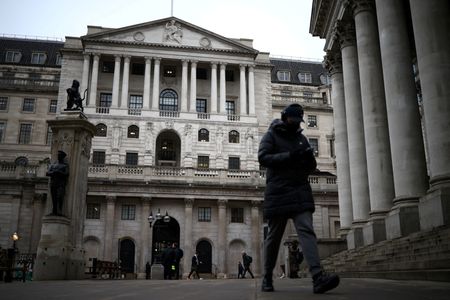
LONDON, June 18 (Reuters) – The Bank of England kept interest rates on hold at 3.75% in June, as it has since the start of the U.S.-Iran war, judging it would be premature to raise rates now given the unclear strength of increased inflation pressures.
The central bank’s Monetary Policy Committee voted 7-2 to keep rates on hold, in line with economists’ expectations in a Reuters poll, after external member Megan Greene joined Chief Economist Huw Pill in calling for a quarter-point rate rise.
But most other MPC members appeared little closer to raising rates, broadly sticking with what Governor Andrew Bailey has called an “active hold” which he views as an effective tightening compared with market expectations of cuts before the conflict.
The BoE’s approach contrasts with those of the European Central Bank and Bank of Japan – which have both raised rates in the past week – and projections from the U.S. Federal Reserve after its first meeting under its new chair, Kevin Warsh, which showed policymakers expected rates to rise later this year.
Sterling weakened slightly against the dollar after the decision, extending sharp losses that followed Wednesday’s Fed decision, to hit its lowest since April 7 while investors continue to not fully price in a BoE rate hike until December.
“For now, the Bank is playing for time rather than going on the attack,” George Brown, senior economist at fund manager Schroders, said. “We think the bar for hikes remains high.”
IRAN DEAL MAY EASE UK INFLATION PRESSURE
In the run-up to the BoE’s June meeting, a tentative truce between the United States and Iran promised to reopen the Strait of Hormuz and lower oil prices, a boon for Britain if the deal sticks as it relies heavily on imported natural gas.
However, the BoE said it was too soon to declare the inflation threat over.
“Whatever happens in the future, the higher energy prices of the past four months means there’s already some inflationary pressure in the pipeline,” Bailey said in a statement alongside Thursday’s decision.
The BoE expects inflation to rise above 3.25% in the final quarter of this year, up from 2.8% in May, though this is a smaller increase than the rise to 3.6%-3.7% which it projected in April under two of its three main scenarios.
The central bank was also marginally more upbeat on growth, estimating the economy is expanding at an underlying rate of 0.2% a quarter, up from 0.1% in its last set of forecasts despite a small fall in output in April.
Both Pill and Greene said a rate rise now was needed to rein in households’ expectations for future inflation, which are their highest since at least 2009 in a quarterly BoE survey, though are coming down on a more frequent monthly survey.
Inflation has exceeded the BoE’s 2% target for most of the past five years due to a series of upward shocks since the COVID-19 pandemic, most notably Russia’s 2022 invasion of Ukraine that lifted British inflation above 11%.
“A proactive hike now in Bank Rate should help anchor inflation expectations,” Greene said.
HIGHER COST OF LIVING HURTING PUBLIC
The rising cost of living has been a key factor behind many Britons’ dissatisfaction with mainstream politicians.
Prime Minister Keir Starmer’s popularity has plummeted since he won a sweeping election victory two years ago, and he faces a potential leadership challenge if Greater Manchester Mayor Andy Burnham wins a parliamentary seat in a by-election on Thursday.
Catherine Mann was the policymaker who appeared closest to joining Pill and Greene to vote for a rate rise, as she judged inflation risks were more prominent than the other MPC members who voted to keep rates on hold.
But in minutes of the decision she agreed there was time to wait as “a forceful Bank Rate decision can have a quick effect on inflation and inflation expectations”.
Deputy Governor Clare Lombardelli said the risk of damaging second-round inflation effects was increasing as high energy prices continued but so far the evidence pointed to a standard pass-through of higher energy prices.
(Reporting by David Milliken and Andy Bruce; additional reporting by Suban Abdulla; editing by Philippa Fletcher)
Brought to you by www.srnnews.com