


By Mike Stone and Aishwarya Jain
WASHINGTON, July 23 (Reuters) – The world’s two biggest defense contractors, Lockheed Martin and RTX, said on Thursday they expect strong profits going forward because a wave of global conflicts from Iran to Ukraine has depleted Pentagon stockpiles that will need replenishing.
Investors cheered the news, pushing shares of Lockheed up 10.6% and boosting RTX 7.7%.
President Donald Trump has been urging defense contractors to increase production as the U.S.-Israeli war on Iran and a prolonged Russia-Ukraine conflict drain the Pentagon’s inventory.
Trump has also proposed a record $1.5 trillion military budget for fiscal 2027. The U.S. House of Representatives this week passed its version of a massive defense policy bill that would authorize an unprecedented $1.15 trillion in spending for the military.
Demand is expected to remain strong. The U.S. has used more than 50,000 rockets, missiles and rocket-propelled munitions since the start of the Russia-Ukraine conflict in 2022 and throughout the U.S. attack on Iran, which began on February 28, according to Pentagon data.
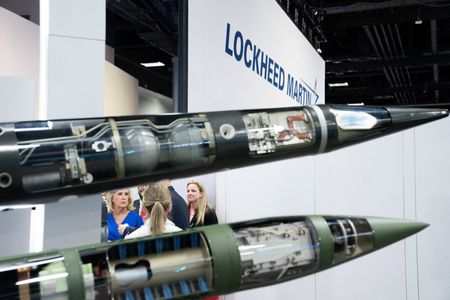
Lockheed’s missiles and fire control revenue rose nearly 20% to $4.1 billion, driven by a production ramp-up of its PAC-3 and precision strike missiles, both of which have been used in the war on Iran in the last few months. The segment was also helped by higher production of its THAAD missile interceptors, after the company signed a $35 billion contract with the U.S. government in June to quadruple output.
“The government is giving us a lot more flexibility than they traditionally would have done… so that we can be faster,” Lockheed Martin’s CEO Jim Taiclet said on the post-earnings call.
“That’s what I hear from the deputy secretary every time we get together and beyond: faster, faster, faster,” he added, referring to U.S. Deputy Secretary of Defense Steve Feinberg.
Lockheed’s total backlog – orders yet to be produced – grew to $230.4 billion, up 38.3% from $166.5 billion last year.
“We’re in active dialogue looking at other potential opportunities. We do see a real opportunity here for more partnerships to scale production faster, particularly in Europe,” Lockheed CFO Evan Scott said on a call with Reuters.
The company now expects 2026 revenue between $79.75 billion and $81.75 billion, up from a prior range of $77.5 billion to $80 billion, and above analyst expectations of $79.14 billion, according to LSEG data.
At RTX, backlog rose 22% from a year earlier to $289 billion, including $170 billion in commercial aerospace orders and $119 billion in defense. Demand for aircraft maintenance, repair and overhaul services has remained strong as supply-chain snags and delayed deliveries have forced airlines to keep older, more expensive fleets flying longer.
Sales at Raytheon, RTX’s weapons business, rose 18% to $8.27 billion, helped by demand for Patriot, Standard and AMRAAM missile systems.
“About half of (Raytheon’s) bookings in the first half of the year, $10 billion, came from international customers. Of that $10 billion, $7 billion came from European customers,” RTX Chief Financial Officer Neil Mitchill told Reuters.
RTX now expects 2026 adjusted sales of $95 billion to $96 billion, up from $92.5 billion to $93.5 billion, above analyst estimates of $94.08 billion. It raised its adjusted profit forecast to $7.10-$7.25 per share, from $6.70-$6.90 previously.
About two-thirds of the increase in RTX’s annual profit guidance comes from Raytheon, and another roughly 25% from Collins, the airplane components business, said Seth Seifman, analyst at JPMorgan.
RTX CEO Chris Calio said on the post-earnings call the company saw potential opportunities in the Middle East amid current developments, noting that RTX had strong customer relationships in both the Middle East and Europe.
Both companies topped Wall Street’s second-quarter estimates.
(Reporting by Mike Stone in Washington; editing by Chris Sanders and Nia Williams)
Brought to you by www.srnnews.com