

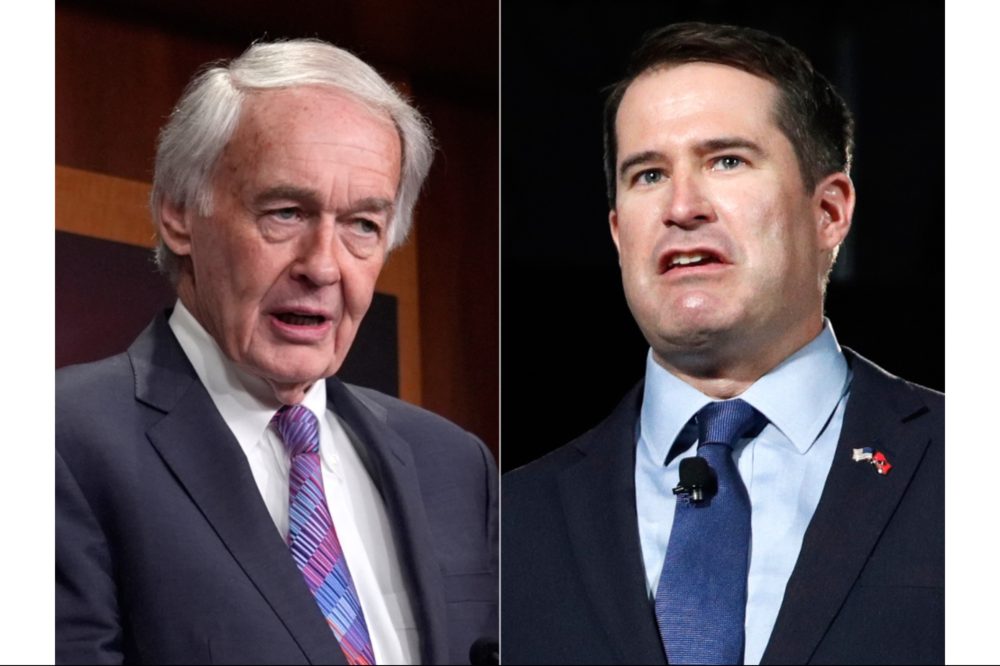
BOSTON (AP) – In a race that has centered on whether Ed Markey, 80, is too old for another U.S. Senate term, the Massachusetts Democrat’s answer to a recent debate question was especially striking.
When asked whether he uses AI platforms like Claude or ChatGPT in his work, Markey seemed unclear on the topic. He responded that he uses “whatever is inside of my iPhone or my iPad – whatever comes up” and added that he doesn’t know “what companies my iPad may be using.”
For Arsen Bagdassarian, an 18-year-old supporter of Markey’s rival, 47-year-old U.S. Rep. Seth Moulton, the answer reinforced a concern that has become central to Moulton’s campaign to unseat the incumbent in Tuesday’s party primary: that Markey, who would be 86 at the end of another term, is too old to represent a generation confronting problems that didn’t exist when Markey entered Congress 50 years ago.
“To be frank, I didn’t expect him to be as clueless as he really was on that topic,” said Bagdassarian, an incoming freshman at Boston’s Northeastern University. Artificial intelligence is “a major concern,” he said, and the country needs leaders “who understand what they’re being asked to regulate.”
The 2026 midterms have brought a number of generational challenges like the one Moulton is waging against Markey, with younger Democrats taking on – and in some cases unseating – longtime incumbents. There are signs that Democratic voters, especially, are looking for change, and some young voters argue older politicians can’t truly understand a world transformed by artificial intelligence, rising housing costs and student debt.
But that hasn’t been the case for all young people voting for the Senate nominee in a heavily Democratic state where the primary often decides who wins office. Markey has a strong following of young supporters, some of whom say that the internal party debate is more over policy than age. He’s won the endorsement of the High School Democrats of America and the College Democrats of America, as well as the backing of popular progressives such as U.S. Rep. Alexandria Ocasio-Cortez of New York and New York City Mayor Zohran Mamdani.
Among those younger supporters is Matt Kelly, president of the UMass Lowell College Democrats. Kelly doesn’t dispute that Markey stumbled when asked about his use of AI, saying, “I’ll admit it wasn’t a good answer.”
But Kelly said he cares less about whether Markey knows how to use the latest technology than whether he understands how to govern it. Moulton’s relative youth, Kelly said, doesn’t necessarily make his views more representative of young voters.
“Just because he has a younger face doesn’t mean that he has younger ideas,” he said.
Many of Markey’s younger supporters turn Moulton’s argument about the senator’s 50-year political career on its head. To them, longevity provides a record they can judge – one that shows whether politicians held the same positions before they became popular with younger voters. One example is Markey’s vote in 2002 against the creation of the Department of Homeland Security, which later led to the creation of U.S. Immigration and Customs Enforcement.
Milan van Dam, a 17-year-old who serves as national chair of the High School Democrats of America, said generational leadership is “less about an age on a Wikipedia page” than the ideas a candidate represents and their consistency through time.
Abby Shadden, a 21-year-old Emmanuel College student, similarly pointed to Markey’s co-authorship of the Green New Deal and his early support for Medicare for All.
“There is this idea that younger people are just automatically more progressive when, in this case, it is very much not true,” she said.
For Kelly, the debate over AI is already playing out close to home. A proposed data center in Lowell, where he attends college, has generated opposition from some residents over its potential impact on the community. Kelly said Markey’s push for greater regulation of data centers matters more to him than the senator’s awkward answer about AI.
Kelly said his generation will be graduating into an economy increasingly shaped by artificial intelligence while facing a cost of living that has made it harder to achieve the same financial security as previous generations.
“Yes, Ed Markey’s answer rhetorically didn’t come off well, optically didn’t look well,” Kelly said. But when it comes to who will be good for “the group that’s graduating into this new economy,” he said, Markey’s record matters more.
Moulton seized on Markey’s debate answer, telling him: “Senator, if you don’t even know what you’re using on your phone or your iPad, like this is why we need a new generation of leaders to regulate these technologies.” Moulton called Markey’s loose grasp of the technology “potentially disqualifying.”
Markey pushed back, saying, “It doesn’t make any difference whether it’s called Siri or it’s called Claude,” and emphasizing that familiarity with individual AI products was less important than putting safeguards around the technology. He pointed to legislation he has introduced to regulate AI’s effects on children, workers, civil rights, and the environment.
Moulton has emphasized Markey’s age throughout the race, calling for “generational change” and age limits for members of Congress.
For some of Moulton’s young supporters, however, the argument is about more than the candidates’ ages.
Molly Blander, an 18-year-old incoming Tufts University freshman, pointed to artificial intelligence and social media as technologies that have reshaped life for her generation – including its mental health. She cited Moulton’s work to establish 988 as the national suicide and crisis lifeline as an example of the kind of response she wants to see.
“Social media has created a modern mental health problem, so we need modern solutions,” Blander said.
“The world before AI is so different than it is now,” Blander added. “I think what was hard to see and hard to understand is that my senator does not understand one of the challenges that we’ve been facing.”
Her generation’s political world has also been shaped by Republican President Donald Trump.
“In my lifetime, I haven’t seen the Democratic Party and the Democratic establishment really make things much better,” she said, pointing to rising housing and energy costs and Trump’s rise and reelection. “And so I feel like the status quo and the establishment that we have now just isn’t working.”
___
Associated Press writer Michael Casey contributed to this report.
Brought to you by www.srnnews.com