


By Andrew Chung
WASHINGTON, July 1 (Reuters) – In May 1996, the U.S. Supreme Court struck down a voter-passed Colorado measure that had denied gay people legal protections against discrimination. It was a landmark ruling under the U.S. Constitution’s promise of equal protection that heralded several other decisions by the court expanding LGBT rights in the decades to come.
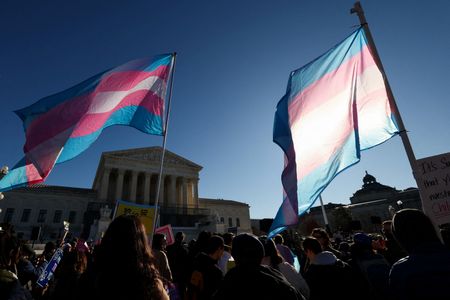
Thirty years later, the tide has turned. The court in another important decision on Tuesday ruled against transgender student athletes, permitting state laws banning them from participating on female sports teams at public schools including universities.
The court rejected claims that the bans enacted in West Virginia and Idaho ran afoul of the Constitution’s 14th Amendment principle of equal protection under the law and the Title IX civil rights statute that bars discrimination in education “on the basis of sex.”
Those laws designated sports teams according to “biological sex” and barred “students of the male sex” from female teams. The states said the laws preserve fair and safe competition for women and girls.
‘SHIFTED DIRECTIONS’
Legal experts said the ruling, issued on the final day of the court’s nine-month term, represented another setback for transgender people fighting a growing array of state and federal restrictions targeting them – and for gay rights more generally.
“The court has clearly shifted directions on LGBTQ rights,” Rutgers Law School professor Katie Eyer said.
“In numerous rulings over the course of the last several terms, they have made clear that they sympathize far more with those who wish to discriminate against LGBTQ people, than they do with LGBTQ people themselves,” said Eyer, an expert in anti-discrimination law.
Advocates for transgender rights sought to emphasize the positive on Tuesday, noting that the ruling was narrowly focused on the sports context and that its reasoning did not foreclose successful challenges to other restrictions on transgender people.
“Other discriminatory laws or government actions will have to be scrutinized to determine whether they can be justified,” said Karen Loewy, a lawyer with the LGBT rights group Lambda Legal.
The court, which has a 6-3 conservative majority, decided 9-0 that the state laws did not violate Title IX. It decided 6-3, along ideological lines, that the laws also did not violate the 14th Amendment. The three liberal justices said a factual dispute in the West Virginia case should have precluded resolving that issue.
In all, 27 of the 50 U.S. states have such laws.
“After today’s decision, the 23 states still on the sidelines have run out of excuses,” said Kristen Waggoner, president of the Alliance Defending Freedom conservative Christian legal group, which helped the states defend their bans.
“This is a victory for every girl who refused to stay quiet in the face of injustice. Men cannot be women, and no drug erases the male athletic advantage,” Waggoner said.
MILITARY BAN
The court’s conservative majority, since last year, has allowed Republican President Donald Trump’s administration to ban transgender people from the military and bar passport applicants from designating their gender identities for the document. And, in a case from Tennessee, it let states ban gender-affirming medical care for transgender youth.
Ruling in favor of a Christian licensed counselor in March, the court rejected a Colorado law that banned psychotherapists from using “conversion” talk therapy intended to change an LGBT minor’s sexual orientation or gender identity.
The court last year also endorsed the right of religious parents to remove their children from school classes when storybooks with LGBT characters are read. And in 2023, it ruled that certain businesses have a free speech right to refuse to provide services for same-sex weddings.
TRANSGENDER RUNAWAYS
The court has also signaled continuing interest in deciding cases involving transgender rights. In a case to be heard in their next term, which begins in October, the justices will consider whether parents in Washington state can pursue a challenge to laws protecting the rights of transgender runaway children who seek gender-affirming care at shelters. A lower court ruled that the parents lacked the necessary legal standing to make the challenge.
The court’s current posture toward transgender rights contrasts with a series of cases expanding LGBT rights, beginning in 1996 in the case called Romer v. Evans, which struck down the Colorado measure denying gay people protections against discrimination.
The court ruled in that case that the state measure violated the equal protection clause because its purpose was to make gay people unequal to others.
“This Colorado cannot do,” the ruling stated. “A state cannot so deem a class of persons a stranger to its laws.”
In the following decades, the court delivered several other historic wins for LGBT rights, including throwing out a Texas anti-sodomy law targeting same-sex individuals in 2003 and recognizing a constitutional right to same-sex marriage in 2015. And in 2020, in a ruling written by conservative Justice Neil Gorsuch, the court decided that U.S. law protects gay and transgender employees from workplace discrimination.
A CONSERVATIVE SUPERMAJORITY
That ruling was issued about four months before conservative Justice Amy Coney Barrett joined the court, replacing the late liberal Justice Ruth Bader Ginsburg. Barrett, the last of three Trump appointees from his first term as president, gave the court its current conservative supermajority.
“The Romer v. Evans case did inaugurate a period in which the Supreme Court increasingly recognized LGBTQ+ rights and delivered victories for LGBTQ+ litigants,” Wake Forest University School of Law professor Marie-Amélie George said.
But the 2023 ruling signaled an end to this expansion, George said.
Tuesday’s ruling “is consistent with its more recent cases, which have demonstrated a deep skepticism of LGBTQ+ rights generally, and transgender rights claims in particular,” George added.
In the 2025 gender-affirming care case from Tennessee, the conservative majority held that the state law did not create a sex-based category, which under the court’s precedents would trigger tougher judicial review, making it harder to defend in court under 14th Amendment protections.
In the sports case, the court recognized that the bans categorize based on sex, but found that they pass tougher scrutiny regardless, because they further the states’ interests in “safety and competitive fairness,” due to biological differences.
The ruling, George said, could most clearly apply to restrictions on the use by transgender students of school bathrooms that correspond to their gender identity.
“The court’s reasoning makes it likely that they would uphold these laws,” George said.
University of Southern California law professor Jessica Clarke said restrooms are different.
“Some courts have reasoned that privacy norms around restrooms are social conventions, not biological ones,” Clarke said.
Lambda Legal’s Loewy said the court sent two signals with Tuesday’s ruling.
“One, that the court still has a long way to go in recognizing the dignity and equality of transgender people, and two, the court is not green-lighting discrimination against LGBTQ people writ large, and is instead issuing narrow opinions assessing the specific contexts in which the discrimination arises.”
(Reporting by Andrew Chung in Washington; Editing by Will Dunham)
Brought to you by www.srnnews.com