

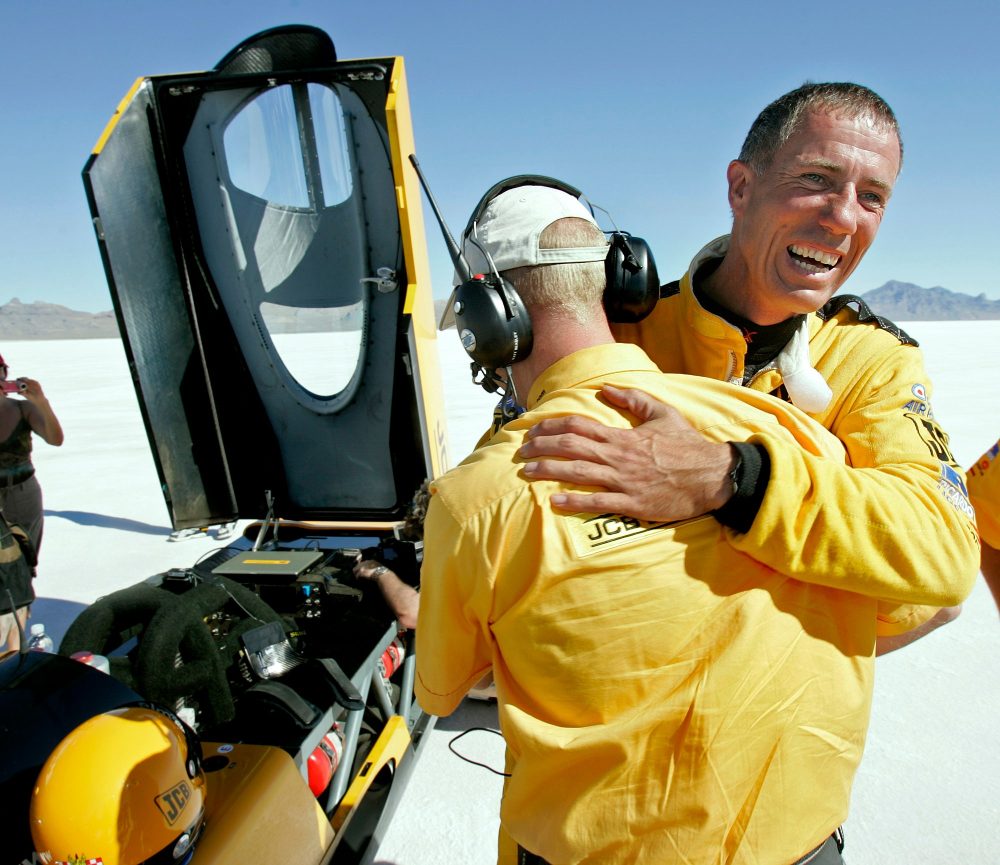
WENDOVER, Utah (AP) – The first – and only – person to break the sound barrier in a car hits the track in Utah this week with new wheels and his eye on another record.
Twenty years ago, British driver Andy Green set the land speed record for a diesel-powered car, reaching 350.092 mph (563.4 kph) at Utah’s famous Bonneville Salt Flats. Green will return to the lunarlike landscape Tuesday and try to beat that mark, this time with a hydrogen-powered car.
The retired Royal Air Force fighter pilot aims not only to win another accolade but to showcase the power of hydrogen as a clean-energy alternative. It’s the “fuel of the future,” Green told The Associated Press in a July interview.
Green will be driving the 32-foot (9.75-meter) JCB Hydromax, the brainchild of British construction equipment manufacturer JCB. The car is bright yellow, long and slim, resembling a pencil. It’s powered by two hydrogen internal combustion engines with a combined 1,600 horsepower, which were adapted from engines used in the company’s construction machinery. They mix pressurized hydrogen gas with air and ignite it to create bursts of power.
In targeting the diesel-powered record, Green also hopes to easily clear the world land speed records for hydrogen internal combustion engines (185.5 mph/298.5 kph) and electric vehicles (341.3 mph/549.2 kph).
Green hit a new top speed of 368.347 mph (592.797 kph) in practice last week, but to officially earn the hydrogen record, he’ll have to do it Tuesday in front of the Fédération Internationale de l’Automobile, the international governing body of motor sports.
“What the peak speed is, I can’t say. We just don’t know,” he said. “Part of the adventure here is we’re going to find out.”
One thing Tuesday’s attempt will assuredly not do is approach the supersonic speeds Green reached with jet power three decades ago.
Green had already been flying supersonic military aircraft when he spotted a newspaper ad that read: “Wanted: High-speed driver to break the sound barrier,” according to the Guinness World Records. In 1997, he traveled faster than the speed of sound and set the outright land speed record – 763.035 mph (1,227.98 kph) – in a car powered by twin jet engines. His runs in Nevada’s Black Rock Desert produced sonic booms that shook the nearby town of Gerlach.
Now 64 years old, Green said he thought he was done racing but came out of retirement when JCB approached him with plans for the new car. The company has invested more than $134 million into hydrogen-powered engines that it says emit no carbon dioxide from the tailpipes.
“If you’re serious about emissions, you have to be serious about hydrogen, and a land speed project is the perfect way to prove it,” JCB Chair Anthony Bamford said at the car’s unveiling in May. Bamford has also argued that hydrogen can better handle the demands of heavy industries than electric power.
But hydrogen is only as clean as its source, and the vast majority is currently produced from fossil fuels. JCB signed a deal to buy green hydrogen, which is created using renewable energy but makes up a tiny fraction of global hydrogen production.
Hydrogen combustion engines also present unique safety challenges due to the high pressure and flammability of the gas.
“We’re managing the risks very carefully,” Green said. The car endured rigorous testing, and Green said he spent months learning how it responds to the elements, how the engines work in tandem and how to deploy a parachute to slow the car on the low-friction salt crust.
Since the first race there in 1914, the glassy surface of the Bonneville Salt Flats has drawn generations of drivers seeking to set new land speed records. A remnant of a prehistoric lake bed, the salt flats are about 100 miles (160 kilometers) west of Salt Lake City and sit atop an aquifer that cools the tires of the cars.
Spectators must stand about a quarter of a mile (400 meters) from the course’s straightaway, which is 10 miles (16 kilometers) long, and often watch through wide-angle binoculars.
The expanse on the border of Utah and Nevada has also been a backdrop for movies including “Independence Day” and “The World’s Fastest Indian,” and the series finale of “Mad Men.”
Green will start about an hour before sunrise Tuesday. His attempt comes a year after a driver going 283 mph (455 kph) died trying to set a land speed record at Bonneville’s annual Speed Week. Chris Raschke lost control of his rocketlike vehicle called the Speed Demon last August and died from his injuries.
___
Rico reported from Atlanta. Video journalist Serge Cartwright contributed reporting.
Brought to you by www.srnnews.com