


By Andrew Hay
July 22 (Reuters) – A private autopsy of Nolan Wells, a Black college football player whose body was found in the ocean near an island off the Mississippi coast, raised questions about the cause of his death, a family lawyer said on Wednesday.
The pathologist who conducted the private autopsy “cannot rule out foul play” without more information, said civil rights lawyer Ben Crump.
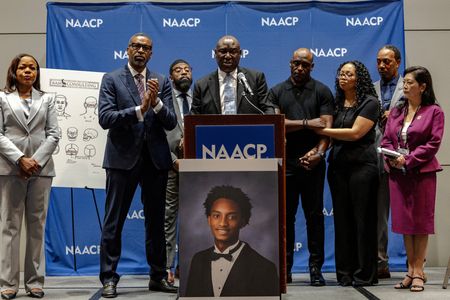
The private autopsy requested information about Wells’ neck and head from the initial autopsy conducted by the Mississippi medical examiner, Crump told a press conference during the NAACP’s National Convention in Chicago.
Wells’ body was found fully clothed and face down in water off the island on July 6. He had traveled there over the Fourth of July weekend with three white friends who returned to the mainland without him, Crump said.
The death has drawn national attention over unanswered questions surrounding his final hours and concerns that deaths of young Black Americans do not receive adequate scrutiny.
Wells, who played wide receiver for Southwest Mississippi Community College, was found off the northwestern tip of the barrier island along the Gulf of Mexico after he visited it with friends he had known from high school in nearby Ocean Springs, Mississippi. His phone was not found with his body but with one of the friends. The friends were also in possession of his keys, Crump said.
Pathologist Roger Mitchell, who carried out the private autopsy, said red discoloration on the back of Wells’ head was of “great concern,” Crump said. To determine the cause of the discoloration, Mitchell requested additional information from Mississippi authorities who carried out the first autopsy.
“Based on the examination of the body he cannot rule out foul play,” Crump said.
Mitchell said in his report he was unable to directly examine Wells’ stomach and airways for the presence of water as they were removed from his body by the first autopsy.
Among the outstanding questions regarding Wells’ death, Mitchell said, were the circumstances that led him to enter the water, his body position when he was found, whether there was water in his airways and whether there was evidence of injuries to his neck and head.
Mitchell also requested information about Wells’ throat, which was not included with the body when he conducted the examination, to help determine whether a neck injury contributed to his death, Crump said.
“This pathologist cannot rule out if any intervening non-accidental factors contributed to or caused the death of Nolan Wells,” Mitchell wrote.
The family’s calls for answers, amplified by civil rights leaders and social media, have fed the larger debate about race in America.
Wells’ mother, Christine Wonsley, expressed concern that local law enforcement officials too quickly ruled her son’s death an accidental drowning and ruled out foul play.
“The question that we have is what happened to our son,” Wonsley said at the press conference.
In a July 7 statement, the Jackson County Sheriff’s Office asked for the public’s help in providing any eyewitness accounts or video and photo evidence related to anything they might have seen on Horn Island on July 4 involving the Wells case.
(Reporting by Andrew Hay in New Mexico; Editing by Kat Stafford and David Gregorio)
Brought to you by www.srnnews.com