


DUBAI, United Arab Emirates (AP) – U.S. President Donald Trump said Thursday he had called off new military strikes on Iran, suggesting progress had been made in talks to end the war just hours after the American leader threatened to escalate the conflict by seizing control of Iran’s oil industry.
Trump said in a social media post that he made the move after a breakthrough in negotiations, and that significant points under discussion “have been brought to the highest level of Iranian leadership and approved.”
The announcement came after two days of back-and-forth attacks between the U.S. and Iran had pushed the Middle East closer to the resumption of a full-scale war.
Trump had threatened further escalation earlier Thursday, posting on social media that the U.S. would hit Iran “VERY HARD TONIGHT” and take “total control” of its oil and gas industries.
A few hours later, Trump wrote that “discussions and final points have been, in both concept and great detail,” approved by United States, Israel, and other regional allies. He did not offer details.
Trump has claimed multiple times in recent weeks that the warring parties have been on the cusp of a deal without anything coming to fruition. There was no immediate comment from Iranian officials or mediators regarding Trump’s latest comments about progress in negotiations.
Talks have stalled over Iran’s nuclear program, which the U.S. and Israel fear could lead to an atomic weapon, but which Tehran says is for peaceful purposes. Another major point of contention is Iran’s stranglehold on the Strait of Hormuz, a critical shipping lane for transporting oil and natural gas.
Trump again moves quickly from threats to negotiating
Trump’s rapid shift Thursday from dire threats to promoting peace negotiations again underscored his whipsaw approach to the war. He suggested on Monday that a deal to end the conflict could be reached in a matter of days.
Then back-and-forth strikes rattled the Middle East this week. The first involved attacks between Iran and Israel, followed by the two rounds of fire between the U.S. and Iran, which targeted countries where U.S. troops are based. The U.S. strikes began after Trump blamed Iran for downing an American attack helicopter near the Strait of Hormuz. Both pilots were rescued safely.
The U.S. military said it targeted Iran’s military surveillance, communications and air defense sites. Iran’s paramilitary Revolutionary Guard said a manufacturing complex was hit, along with a military barracks and a Guard base outside Tehran.
Tehran said it fired back at Kuwait, Jordan and Bahrain, which said an 11-year-old girl was hurt and cars and homes were damaged by debris from intercepted Iranian strikes.
Iran’s Foreign Ministry said the U.S. attacks had “effectively rendered the ceasefire … meaningless,” without saying it was abandoning it.
After Trump threatened more attacks were to come on Thursday, Iran’s parliamentary speaker, Mohammad Bagher Qalibaf, responded on social media that “wrong strategies and impulsive decisions” would wreak havoc on energy markets and “create an endless quagmire that you will be stuck in for years.”
It wasn’t the first time Trump threatened escalation before giving negotiations another chance. In April, he warned Iran that “a whole civilization will die tonight, never to be brought back again” if it didn’t agree to his terms, before extending a ceasefire.
Trump threatened to seize Iran’s main oil terminal
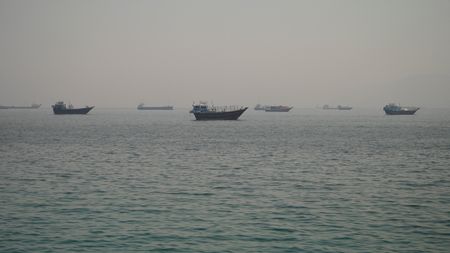
Iran’s monthslong disruption of shipping through the Strait of Hormuz has crimped global energy supplies, driven up fuel prices and made food and other basics more expensive well beyond the region.
Trump had threatened Thursday to seize Kharg Island, the heart of Iran’s oil industr y, through which 90% of its exports pass.
But Trump himself soon voiced doubts about taking over the oil terminal, saying in an interview with Fox News: “I don’t know that America has the stomach for it, to be honest.”
U.S. Treasury Secretary Scott Bessent said in a social media post that the U.S. would extract funds from frozen Iranian accounts to offset the costs of damage to American allies and any tolls Iran imposes for ships to transit the Strait of Hormuz.
Beyond the deadlock over the strait and sharp divisions over Iran’s nuclear program, Tehran has insisted that any deal to end the war must also end fighting in Lebanon between its ally militia Hezbollah and Israel.
But Israeli Prime Minister Benjamin Netanyahu appears intent on pursuing his goal of destroying the militant group, further complicating negotiations with Tehran.
Criticisms over US strike that killed 3 Indian sailors
The U.S. faced criticism Thursday for an American military strike that killed three Indian sailors on an oil tanker near the Strait of Hormuz.
The U.S. military said it fired Tuesday to disable the Palau-flagged tanker M/T Settebello as it attempted to breach a U.S. blockade of Iranian ports while carrying a shipment of Iranian oil. Three Indian crew members were killed, India’s minister overseeing ports and shipping said Thursday on X.
The leader of the International Maritime Organization, a United Nations agency, condemned the attack. India’s foreign ministry summoned a senior U.S. diplomat to convey its “deepest concerns” and formally protest the strike, spokesperson Randhir Jaiswal said.
The U.S. State Department said it was “in direct contact” with the Indian government regarding the strike, but offered no further details.
The U.S. military’s Central Command said American forces issued warnings before firing on the ship. It’s one of nine merchant vessels the U.S. military has disabled to enforce the blockade.
Iranian student says hope dwindles as attacks escalate
A 25-year-old student in northern Iran says Iranians are fearing “chaos” amid the war and multiplying crises at home.
The student, who lives in the city of Babol, said many Iranians are struggling to afford groceries in the face of mass job losses and triple-digit food inflation. He spoke on the condition of anonymity out of security fears.
“Everything is going wrong and there is no hope among the people,” the student added.
The student first spoke to The Associated Press before the war when he participated in widespread anti-government protests. He now says his chief concern is that Iran “maintain territorial integrity and deterrence” in the face of attacks by the U.S. and Israel.
Brought to you by www.srnnews.com