

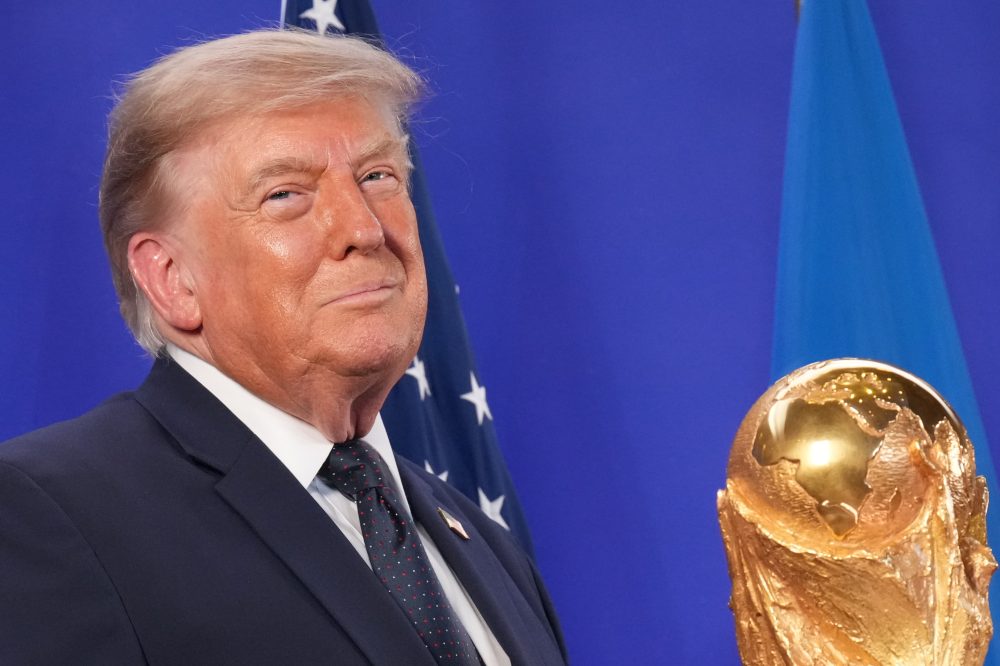
NEW YORK (AP) – President Donald Trump is set to present the World Cup trophy to the winner of Sunday’s final between Argentina and Spain. But to him, the real victor of soccer’s premier tournament just might be the United States.
“It turned out we were a soccer country, and I think it’s going to remain,” Trump said Friday at a FIFA reception at Trump Tower in New York City. “This has really brought the world together.”
For the White House, Sunday’s match is the culmination of well over a year of navigating a litany of logistical challenges alongside co-hosts Canada and Mexico for what would be the biggest World Cup in history. It had to balance the Trump administration’s hard-line migration policies that barred fans from some World Cup qualifier countries from entry into the United States.
The White House faced warnings from human rights groups, and the tournament confronted backlash over high ticket prices. For months, Trump flirted with the idea of moving games out of cities that did not cooperate with federal immigration authorities, and in the weeks before the tournament’s start, local authorities sparred with FIFA over high transit costs, heightening tensions even more.
As the first games were preparing to begin, the administration continued to find itself under global scrutiny for its visa decisions, such as denying entry to a referee from Somalia who had won accolades for his officiating. The pressure increased after Trump launched a war with Iran, leaving the administration to grapple with an Iranian team whose fans and some supporting personnel were barred from the U.S, and that ultimately was based across the border in Tijuana.
But the broader story of the World Cup eventually shifted. Social media was flooded with tales of soccer fans from around the world enjoying the treats and traditions of the U.S., from beer to ranch dressing. Some fears about the Trump administration that circulated beforehand, such as the threat of immigration enforcement raids near the games, never materialized.
“One of the things that we talked about beforehand was, if we’re talking about what happened on the pitch, then we’ve done our job,” Andrew Giuliani, the executive director of the White House FIFA Task Force, said in an interview with The Associated Press. “But I think it’s even better than that. We’re not just talking about only the incredible, athletic feats on the pitch, but we’re talking about all these incredible, incredible cultural moments.”
Still, Trump did create controversy with a phone call he made to FIFA chief Gianni Infantino earlier this month in which he asked for a review of a controversial referee call in Team USA’s match against Bosnia and Herzegovina. The referee gave a red card to U.S. star forward Folarin Balogun, meaning he wouldn’t be able to play in the subsequent match against Belgium.
Trump says he simply asked Infantino, who has cozied up to the U.S. president and faced backlash for doing so, to review the call. FIFA then reversed the call, and Trump told Infantino at the FIFA reception on Friday that “you made another great decision, if you think about it,” because it allowed the U.S. to keep a key player on the field even though the team lost the match to Belgium 4-1.
Giuliani said the administration had a “duty” to ask questions and raise concerns about the officiating process, which drew scrutiny because of the use of video review and slow-motion replay to issue the red card. He noted that the Trump administration invested billions in federal funding to ensure that the World Cup was “not just a safe and secure event, not just where we welcomed the world, but an event that was filled with integrity.”
The Trump administration was under considerable pressure to pull off a successful World Cup tournament because the U.S. will soon host the 2028 Summer Olympics in Los Angeles and the 2034 Winter Olympics in Salt Lake City.
The U.S. is also largely expected to be awarded the 2031 Women’s World Cup, although Giuliani said in the AP interview that part of getting those hosting duties will be “ensuring that, in fact, women and only women will play in that 2031 Women’s World Cup” – an allusion to the Trump administration’s fierce opposition to transgender women participating in women’s sports.
Sen. Andy Kim, D-N.J., a self-professed World Cup superfan whose home state is hosting Sunday’s final, noted that logistics for the tournament have gone mostly smoothly, aside from the occasional hiccups on some issues such as transit to the games.
But “overall, just the joy that people have, the excitement that they have, has dramatically outweighed” any downsides, Kim said, who has been eagerly watching the games with his two young sons over the last several weeks.
The U.S. also faced broader tensions with its World Cup co-hosts of Canada and Mexico. Trump announced stiff tariffs on both countries in his return to the White House, and he has chosen not to renew a trade pact among the three countries, setting up a new period of negotiations.
On Friday, Trump threatened to tariff Canada over its wildfires, which have hurt air quality in parts of the U.S., including northern New Jersey where the World Cup final is being held. He joked on Friday that FIFA should choose the U.S. for the World Cup soon again, and “this time, we’ll leave Mexico and Canada out.”
Still, Mexican President Claudia Sheinbaum and Canadian Prime Minister Mark Carney plan to attend the final at Trump’s request, in a sign that soccer can overcome some geopolitical tensions.
“I received an invitation from President Trump to attend the World Cup final on Sunday, and I decided to go because it’s a direct invitation from the President of the United States,” Sheinbaum said. “Prime Minister Carney will also be there.”
Trump, as is generally customary for heads of state hosting the tournament, will present the trophy to the eventual winner. But he hasn’t tipped his hand publicly about whether he has a preferred team.
Spain is a known irritant to Trump, with its reticence to meet NATO defense spending goals and its refusal to let the U.S. launch strikes against Iran from its bases. Meanwhile, Argentine President Javier Milei is a favorite of the Trump administration, with the U.S. president going as far as to threaten to cut aid to the country if Milei’s coalition didn’t prevail in legislative elections.
Spanish Prime Minister Pedro Sanchez plans to attend the game, although Milei – citing superstition – will stay at home.
___
Kim reported from Washington. Associated Press writer Joey Cappelletti in Washington contributed to this report.
Brought to you by www.srnnews.com