

By Ragini Mathur and Avinash P
July 8 (Reuters) – Wall Street’s main indexes fell on Wednesday after President Donald Trump said an interim deal aimed at ending the war with Iran was “over,” while Broadcom led gains among recently battered chip stocks.
Speaking at the NATO summit, Trump said he had no interest in further talks with Iran and warned that Washington was likely to carry out additional strikes on Wednesday night.
His comments marked the latest setback in the series of back-and-forth in negotiation talks that have swung between threats of escalation and hopes for diplomacy, leaving investors wrong-footed by several false starts toward a peace deal.
Broadcom gained 4.2% after Apple said it plans to spend more than $30 billion as part of a chip-supply agreement reached earlier this week with the chipmaker.
“Any time you get an announcement from Apple about using your equipment, it’s pretty positive – especially when you have 2.5 billion Apple devices in people’s hands around the globe,” said Art Hogan, chief market strategist at B. Riley Wealth.
Nvidia pared early losses and turned positive after the Information reported that China plans to allow its top AI firms to buy a limited number of the company’s H200 chips.
The chip stocks were mixed on Wednesday after recent volatility, with the broader Philadelphia SE Semiconductor index down 0.08%.
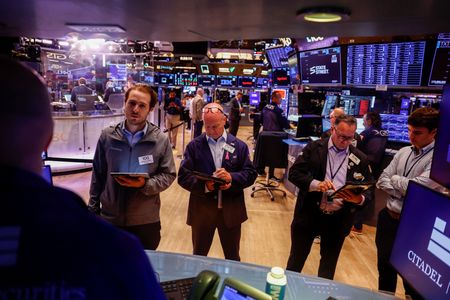
At 12:04 p.m. ET, the Dow Jones Industrial Average fell 774.50 points, or 1.46%, to 52,150.65, the S&P 500 lost 66.94 points, or 0.89%, to 7,437.21 and the Nasdaq Composite lost 235.63 points, or 0.91%, to 25,584.18.
Oil prices sharply extended gains on the day following Trump’s remarks, with Brent crude futures surging 7%. Treasury yields also rose as the selloff spread to bonds. [US/]
The latest escalation in the conflict threatens to unsettle the equities rally that has carried the benchmark S&P 500 up about 9% so far this year, despite sharp declines earlier in 2026 after the Mideast war started.
A renewed jump in oil prices could revive inflation concerns and further complicate the Federal Reserve’s path.
Nine of the 11 sectors on the S&P 500 were trading in the red, except for energy and consumer staples.
Energy price-sensitive travel stocks fell as higher oil prices stoked concerns over fuel costs and demand. United Airlines dropped 4.4% and Delta Air Lines fell 3.4%.
Cruise operators also slipped, with Carnival down 5.1%, and Norwegian Cruise Line 4%.
Small-cap Russell 2000 index fell 1.6% to three-week lows. The CBOE Volatility Index, Wall Street’s fear gauge, hit an over one-week high. It was last up 2.4 points at 18.54.
FED MINUTES, IMF WARNING IN FOCUS
Meanwhile, the International Monetary Fund on Wednesday once again lowered its 2026 global growth forecast to 3%, warning of ongoing risks posed by the war in the Middle East.
The Fed’s June policy meeting minutes are due later in the session. The readout could offer better clues on how policymakers are assessing inflation risks and economic growth.
“In the past… you tended to have less of a market-moving event with the minutes. I think this may be different,” said Hogan.
Traders are currently pricing in at least one rate hike by the end of 2026, according to LSEG data.
Declining issues outnumbered advancers by a 3.6-to-1 ratio on the NYSE, and by a 3.56-to-1 ratio on the Nasdaq.
The S&P 500 and the Nasdaq Composite posted no new 52-week highs and no new lows.
(Reporting by Ragini Mathur and Avinash P in Bengaluru; Editing by Pooja Desai and Shinjini Ganguli)
Brought to you by www.srnnews.com