


By Elisa Anzolin
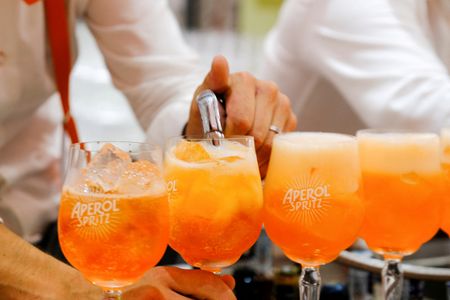
MILAN, July 10 (Reuters) – Campari is stepping up efforts to defend Aperol, the driving force behind its growth in recent years, as copycat spritzes and rival aperitifs vie for a slice of the booming market.
At home in Italy, where competition is fiercest, the spirits group has launched a promotional campaign and a loyalty programme for trusted retailers.
A broader rollout of pre-prepared Aperol Spritz kegs should help guard its position in the global spritz market, where consumption rose to nearly 4 billion servings in 2024 from less than 2.5 billion in 2019, according to data provider IWSR.
The Aperol brand is Campari’s biggest earner, accounting for about 26% of revenue. Sales helped the company stay resilient last year as the sector dealt with weakening consumer demand.
Outlining plans in November to streamline its brands, the group said the orange aperitif was a “top priority” and would be a main focus of advertising and promotional activity.
The recipe for the century-old Aperol bitter, the key ingredient in the world’s most popular spritz cocktail, is a closely guarded secret.
But that hasn’t stopped a growing number of lookalike products and rival aperitifs from seeking to muscle in – first in major European supermarket chains and increasingly in bars and restaurants.
“The new development is that, since 2023, some bars and restaurants have begun serving orange-coloured drinks, often from tap, that are not necessarily made with Aperol,” said Andrea Neri, managing director of House of Aperitivi at Campari, adding that consumers often think they are drinking the original.
Italy, where the Aperol Spritz originated and consumers have long enjoyed light cocktails of similar bittersweet flavour, is Campari’s second-largest single market after the United States.
Alternative cocktails and spritz-style drinks within the aperitif category present another challenge. For example, paler rival Hugo Spritz – made with elderflower syrup or liqueur and Prosecco – is crowding U.S. summer menus and increasingly seen in pubs and bars in Britain.
ORANGE BUT NOT NECESSARILY APEROL
Neri said the use of lookalike products in bars has so far been largely limited to Italy and has coincided with the increasing use of ready-made mixes to speed up service.
Campari has hit back. In recent months, the company has launched its own pre-prepared Aperol Spritz in kegs and rolled out a communication campaign highlighting that not all orange-coloured drinks are genuine Aperol Spritzes.
It has also introduced a loyalty programme for bars and restaurants that certifies the sale of original Aperol Spritz cocktails, now covering 2,000 venues in Italy.
While Aperol brand sales continue to grow – globally, by 1.4% last year, to €785 million ($897 million) – it is difficult to gauge the potential impact of lookalike products.
“We could probably have grown even faster,” Neri said, referring to Italy, while noting that the company has no precise data quantifying its effect.
Last year, Campari spent about €547 million on advertising and promotions, equivalent to 17.9% of net sales.
LOOKALIKES ON THE SUPERMARKET SHELF
In supermarkets, shelves dedicated to aperitifs are increasingly populated by orange drinks whose appearance closely resembles Aperol. These can be 30-40% cheaper than a bottle of Aperol, which retails in Italy for about €10.
The colour has become so strongly associated with the brand that Campari has sought to protect it through trademark registrations as part of broader efforts to defend its intellectual property. The group has also pursued legal action against small competitors in some cases.
The presence of similar products in supermarkets “is not a new phenomenon and can be observed across Europe”, Neri said, playing down its impact on Aperol sales.
“The fact that there are lookalike products is a sign that Aperol is a very strong brand,” said Sandro Castaldo, professor of marketing at Bocconi University, noting that colour is often the first element copied by imitators.
HUGO THREAT?
The success of Aperol has also whetted appetites for similar summer drinks such as the Alpine-born Hugo Spritz.
Many American recipes and bar menus use St‑Germain, the French elderflower liqueur owned by Bacardi, as the key ingredient for Hugos.
Bacardi told Reuters that St-Germain had seen double-digit sales growth year-on-year, fuelled by a rise in Hugo Spritz popularity, citing IWSR data.
In Europe, Campari itself has introduced Sarti Rosa, a fruit aperitif, with a viral marketing campaign for spritzes based on the hot pink drink aimed at female consumers.
Neri noted that consumers are gravitating towards lower-alcohol aperitif drinks rather than traditional cocktails, while daytime consumption is also rising.
“As the category leader, we have worked to expand our spritz portfolio across multiple brands,” he said.
The group’s aperitif lineup includes the Campari brand, as well as Sarti, Cynar, the non-alcoholic aperitif Crodino and an elderflower aperitif called Mondoro.
Analysts said Campari should continue to benefit from a trend that it has helped to spark.
“I don’t see lookalike products representing a threat for now,” AlphaValue’s analyst Theodore Duval-Segard told Reuters.
“Campari has literally reinvented the spritz. At this point, Aperol and spritz are almost inseparable.”
($1 = 0.8750 euros)
(Additional reporting by Emma Rumney in London, Editing by Keith Weir and Catherine Evans)
Brought to you by www.srnnews.com