

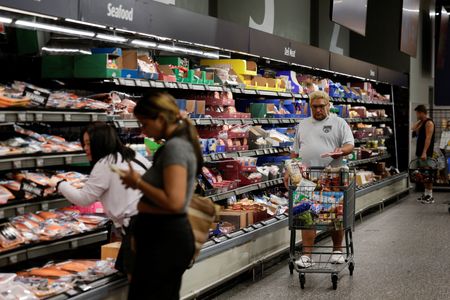
NEW YORK, Nov 10 (Reuters) – US consumer prices increased more than expected in October, leaving the Federal Reserve on course to raise interest rates next month.
The Consumer Price Index rose 0.4% last month after advancing 0.6% in September, the Labor Department’s Bureau of Labor Statistics said on Tuesday. Economists polled by Reuters had forecast the CPI climbing 0.3% over the month.
The BLS did not publish year-over-year inflation readings because last year’s federal government shutdown prevented the collection of consumer price data in October 2025, leaving no comparison base. Annual consumer inflation jumped 3.7% in September.
Inflation is running well above the US central bank’s 2% target. The US-Israeli war with Iran has boosted oil prices, combining with the import tariffs implemented by the Trump administration last year to lift the cost of living.
Excluding the volatile food and energy components, the CPI increased 0.3% last month after gaining 0.3% in September. The so-called core CPI was forecast to have climbed 0.2% in October.
The data follows comments from Fed Governor Christopher Waller that the US central bank ought to raise short-term borrowing costs in December even if data shows inflation cooled last month. He added that it should consider an upsized half-point rate hike if the inflation picture worsens.
MARKET REACTION:
STOCKS: U.S. stocks tumbled, with futures tracking the Nasdaq falling 1.4% and those tracking the S&P 500 down 0.8%.
BONDS: Yields rose. US two-year yields, which are sensitive to the outlook for interest rate moves, soared 13 basis points to 4.68% . The benchmark 10-year yield rose 7.6 basis points to 4.94%.
FOREX: The U.S. dollar index rose 0.3% to 102.05.
COMMODITIES: Gold fell 2% to $4,057 an ounce.
COMMENTS:
ROBERT PAVLIK, SENIOR PORTFOLIO MANAGER AT DAKOTA WEALTH IN FAIRFIELD, CONNECTICUT:
“It’s not a surprise. Inflation has been running hot. It all boils down to the same thing – the war, which is impacting oil which is impacting energy, which is impacting basically everything else and driving everything higher. It’s all based on the same thing, this asinine war. And the Federal Reserve is doing something just as stupid trying to raise interest rates to counteract a drop in supply.
“We’re so dependent on oil for our daily lives, plastic and getting food to the market and just getting food grown and, you know, shipped. Eggs don’t walk to the market themselves. The farmer has to heat the hen house. He’s not doing that by burning wood. So, it definitely has a major impact. And whoever talked Trump into doing this war should be not only fired but should be put on the moon.
“Despite the fact that oil prices have come down recently, it’s not going to have a major impact because it hasn’t affected the price at the pump. I still see it over $4.20 a gallon. I still see diesel being offered at extremely high levels. It’s going to take a long time for those prices to drop. That’s going to impact consumers and it’s going to impact spending and then we’re going to start talking about it as we get closer to the holidays. It’s a never-ending unfortunate cycle right now.”
JOE SALUZZI, PARTNER, CO-HEAD OF EQUITY TRADING AT THEMIS TRADING IN CHATHAM, NEW JERSEY:
“It was hotter than expected and it is making some people pause. Particularly, a couple of governors, one governor on the Fed has suggested that if it was high, they could potentially do a half-point rate hike by the end of the year. I think that’s too much now, but a quarter-point hike seems to be in play at this point. The number is higher, and it’s proven that inflation is sticky.
“But overall, as these rates and inflation stay high, it will continue to keep interest rates high, which will continue to put pressure on some of these companies that rely on borrowing and that could hurt their earnings, which eventually will be reflected in stock prices. Overall, they’ve kind of gotten away with it for a while, but as this continues, I would expect more pressure on stocks.”
JAMES MCCANN, SENIOR ECONOMIST, EDWARD JONES, BOSTON:
“It’s the latest inflation disappointment or the latest print that’s come in stronger than expected. It tells us a few things. One, maybe there’s some fears that underlying price pressures are starting to build again. If we look at the economic growth and the labor market, I think there’s been clear signs of an acceleration this year. So, when we see core inflation starting to show signs of re-accelerating, it creates some concern that underlying inflation pressures are starting to build.
“Back in 2021 was the last time that we hit sustainably the Fed’s inflation target. So, the real concern is, are we going to get back there? Is inflation just settling into a higher trend? All this raises the risk that the Fed is forced to do a bit more on the tightening front. Most market participants have been expecting a quarter point at its December meeting. This cements that the least that the Fed will do. The bigger debate now is whether the Fed needs to do a 50-basis point move and move more aggressively.”
SKYLER WEINAND, CHIEF INVESTMENT OFFICER, REGAN CAPITAL, DALLAS:
“Tuesday’s CPI was stronger-than-expected, which sets the stage for another rate hike in December, as it’s clear the Federal Reserve can’t ignore the obvious uptick in the inflation data. Voters expressed their frustration with inflation and rising prices in the midterm elections, so the Fed must follow through in raising interest rates to curb further inflation.”The most recent jobs report, showing impressive job growth in October along with upward revisions to the prior months, was the cover the Fed needs to be able to keep raising interest rates. It’s clear the Fed can hike a little bit more in an effort to calm inflation without harming the labor market, as the labor market is already on sound footing.”
BRIAN JACOBSEN, CHIEF ECONOMIC STRATEGIST, ANNEX WEALTH MANAGEMENT, MENOMONEE FALLS, WISCONSIN:
“Core CPI was once again at 0.3% m/m. It’s not just headline CPI that is too high, but the oil shock has seeped into core.
“Chicago Fed President Goolsbee isn’t a voter this year, but he probably speaks for a lot of officials when he points to AI demand as being something the Fed might need to lean against. Governor Waller said he could support a super-sized hike. The Fed is probably now more concerned about the idea of AI crowding out other activity and pushing up prices. Forget about oil. The new Fed worry is the cost of hiring plumbers and electricians.”
PETER CARDILLO, CHIEF MARKET ECONOMIST, SPARTAN CAPITAL SECURITIES, NEW YORK:
“(The data) is a bit hotter than we were looking for. And since you can’t see what it was on a year-to-year basis because there’s nothing to compare it to. This just simply means that a rate hike in December it’s on its way. Question is, will it be 25 or 50 basis points?
“Interestingly enough, Governor Waller basically opened the door for perhaps a half-point hike in December. This number suggests that inflation is still a little bit of a problem. So rates are likely to go higher.
“All of this could change within the next 30 to 40 days once lower oil prices begin to work their way into the system, unless oil prices reverse and go back up. But Trump is making it clear that the war is likely to end fairly soon, and that additional airstrikes are not likely. That’s a good indication that if oil prices stay at present levels, we should begin to see lower inflation.”
(Reporting by Lucia Mutikani, P. Avinash, Chuck Mikolajczak, Stephen Culp, Utkarsh Hathi, Tharuniyaa Lakshmi, Sinead Carew; editing by Colin Barr)
Brought to you by www.srnnews.com