


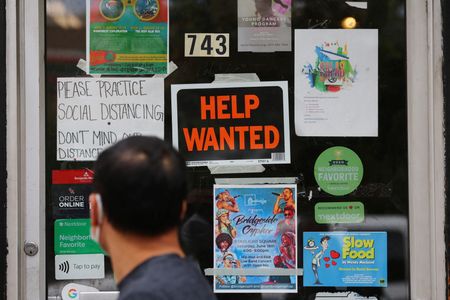
NEW YORK, Nov 6 (Reuters) – US nonfarm payrolls rose more than expected in October and the unemployment rate fell to 4.1%, suggesting the labor market remained resilient and giving the Federal Reserve more scope to focus on inflation stemming from the Middle East conflict.
Payrolls rose by jumped by 165,000 jobs last month after an upwardly revised 60,000 gain in September, the Labor Department’s Bureau of Labor Statistics said on Friday. Economists polled by Reuters had forecast payrolls advancing 65,000 after a previously reported 29,000 increase in September.
The unemployment rate declined from 4.2% in September.
MARKET REACTION:
STOCKS: US stocks were mixed following the report, with the Nasdaq up 1.7% and the S&P 500 up 0.6% and the Dow Jones Industrials down 0.6%.
BONDS: Treasury yields rose after the data was released before pulling back, with the 2-year yield up 6 basis points at 4.52%, the 10-year yield up 3 basis points at 4.87% and the 30-year yield up 2 basis points at 5.27%.
FOREX: The US dollar index was up 0.7% to 102.22.
RATE EXPECTATIONS: Bets that the Fed will raise rates next month rose to 78% following the data from 70% earlier.
COMMENTS:
ANSHUL SHARMA, CHIEF INVESTMENT OFFICER, SAVVY WEALTH, NEW YORK:
“This was a much stronger report than expected, and to us the upward revisions are just as telling as the headline beat. Payrolls beat by over 100,000, and August and September were revised up by a combined 84,000. Hiring has now averaged about 137,000 a month over the past three months, a much healthier pace than the market was pricing in.
“Professional and business services added 70,000 jobs. That’s the white-collar segment many assumed AI was hollowing out, and it’s been growing steadily for a year. One notable soft spot: involuntary part-time work jumped by 339,000. There’s still slack under the surface, so this isn’t an overheating labor market.
“Good news on jobs is complicated news on rates. We’d keep bond duration short to intermediate rather than reaching for long bonds. After yesterday’s tech selloff, we’d use volatility to rebalance with discipline, not to chase or panic.
“We believe this keeps a December hike on the table, with wages up 0.4% for the month. The bigger swing factor is still inflation, especially energy. We’ll be watching November CPI. Our base case: steady growth, rates higher for longer, and a market that rewards earnings and quality over momentum.”
STEVE KOLANO, CHIEF INVESTMENT OFFICER, INTEGRATED PARTNERS, WALTHAM, MASSACHUSETTS:
“Numbers came in better than expected at 165K, compared with estimates of 70K, with previous revisions also trending upward. This confirms and supports the narrative we’ve been seeing in other data this week, as well as the steady decline in initial jobless claims over the last few weeks.
“Interestingly, private payrolls were also well above expectations, which is a positive given the government job erosion we’ve seen over the last few years. Lastly, with unemployment ticking down while the labor participation rate ticked up, all indicators point to a solid employment report.
“With this, the focus going forward will turn squarely to the path of inflation as the key determinant of monetary policy. With any type of political pressure now easing on the Fed, the path of inflation, and energy prices in particular, will likely drive policy expectations. Currently, markets are looking for a 25-basis-point hike in December, followed by potentially a quarter-point hike each quarter in 2027 until a steady and confirmed path of declining inflation can be seen.
“Given the backdrop and what rates have already done, extending duration in bond portfolios becomes a more realistic narrative, with expectations of inflation being contained.”
TIM HOLLAND, CHIEF INVESTMENT OFFICER, ORION, OMAHA, NEBRASKA:
“The US economy added 165,000 jobs in October while the unemployment rate fell to 4.1%, versus Wall Street estimates of 65,000 new jobs and an unemployment rate of 4.2%. The positive data points are welcome, particularly in light of very depressed consumer sentiment.
“That said, today’s labor market reports should make a Fed rate hike more likely and should push up bond yields, headwinds for a stock market that is already struggling with political and policy uncertainty around the AI cap ex cycle. Until we get clarity on that front, we expect risk assets to remain volatile and on the back foot, regardless of how resilient the US labor market is proving.”
SUSANNAH STREETER, CHIEF INVESTMENT STRATEGIST, WEALTH CLUB, LONDON:
“This is a bit of a hawkish jobs report for the Federal Reserve and I think it does make an interest rate cut less likely in the near term. It strengthens the argument for keeping rates higher for longer.
“It does offset some of the concerns about the drag on the economy if there is a slowdown in the build out of data centres and if there’s an increase in AI regulation.
“Because the focus has instead been drawn to the impact of the AI slowdown on the US economy. It may actually come as relief. And could help settle stocks.
“We are in line for still a couple of rate hikes between now and late next year, but much is going to depend on the trajectory of the war with Iran, because there’s still so much uncertainty swirling.”
JOE SALUZZI, PARTNER, CO-HEAD OF EQUITY TRADING AT THEMIS TRADING IN CHATHAM, NEW JERSEY:
“These are very good numbers. Even the revisions from last month are good. It shows that the economy, at least in the labor market, seems very strong. Even our average salary earnings were up.
“So certainly this goes into the camp that the Fed might raise again in the next meeting. … But the flip side of that is that what we saw yesterday and how volatility has spiked – will the Fed want to raise interest rates in the face of a market which is teetering?
“We don’t know what it’ll look like next month, of course, but yesterday was obviously a very bad day. Volatility spiked. So, if tomorrow was a Fed meeting, I would say that we’re not going to raise rates just based on that. But we’ll have to see what it looks like coming next time they meet.”
BRIAN JACOBSEN, CHIEF ECONOMIC STRATEGIST, ANNEX WEALTH MANAGEMENT, MENOMONEE FALLS, WISCONSIN:
“I guess the Fed was right to upgrade its economic assessment from solid to strong, at least based on the October employment report. The headline number blew the consensus out of the water by 100,000. The back-month revisions added 84,000 more jobs.
“Average hourly earnings grew what would usually be a respectable 3.1% year-over-year, but when inflation was higher than that, real average hourly earnings declined. That’s the affordability crisis in one stat.
“Fixing affordability is above my pay grade and even above Congress’s pay grade when it is driven by high oil prices. The vice president, and even the president, are acknowledging that. Lower oil prices, lower gasoline prices, lower inflation, and less pressure on the Fed to hike could help so many areas of the economy that an AI datacenter buildout slowdown might end up not being the growth killer so many people think it could be.”
PETER CARDILLO, CHIEF MARKET ECONOMIST, SPARTAN CAPITAL SECURITIES, NEW YORK:
“This is a good number. It shows that the labor market is extending a long period of growth. The downtick in total unemployment – not too sure why that happened, because the participation rate actually went up.
“Hourly wages were a little bit higher than we were looking for. With a 4% unemployment rate, we are at full employment, right? The jobs market is at full capacity. So with the early wages moving up to 3.1% on a yearly basis, that just confirms that the Fed has no choice but to raise rates in December. And the question is, do they raise by 25 basis points or by 50 basis points?”
(Reporting by Lucia Mutikani, Stephen Culp, Chuck Mikolajczak, Utkarsh Hathi; Darshan Kumar; Laura Matthews; editing by Colin Barr)
Brought to you by www.srnnews.com