


By Nicole Jao and Arathy Somasekhar
NEW YORK, Nov 19 (Reuters) – Restarting a shuttered refinery near Houston, Texas, will be a costly test of President Donald Trump’s agenda to boost US fuel output as prices surge amid a global supply squeeze, with analysts estimating the total price tag could reach $1 billion.
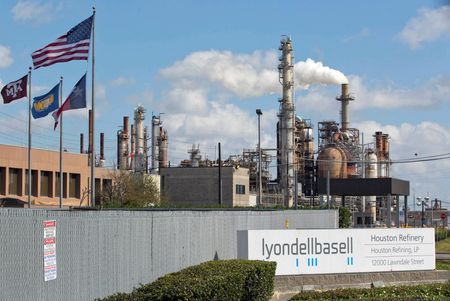
Refiner Valero Energy agreed to buy the century-old LyondellBasell refinery for $320.5 million in October and restore a portion of the facility, returning 165,000 barrels per day of processing capacity by end-2027. The transaction is set to close in the fourth quarter.
The deal is the first of several recently announced projects to add new capacity along the US Gulf Coast, among the top refining belts in the world. US refiners are bucking a global trend of plateauing capacity as margins surge due to wars in Iran and Ukraine and as Washington pushes to expand domestic fuel output.
The plan would reverse years of refinery closures in the United States and add about 1% to overall US refining capacity of 18 million bpd. It comes despite long-term forecasts for declining US gasoline demand because of increased electric vehicle adoption and improvements in vehicle efficiency.
US Energy Secretary Chris Wright has stressed the Trump administration’s support for the refining sector, saying his department is “talking about reopening every refinery we can.”
Even so, the restart will not ease current high fuel prices because the refinery will not start producing fuel for at least another year, said Energy Aspects analyst Raul Calzada.
Restarting idled facilities also comes with a unique set of challenges. US regulators cited health and environmental concerns when rejecting an attempt to restart the St. Croix refinery in the US Virgin Islands, which was shut in 2021 after a chemical release sickened residents.
Valero did not respond to questions about the estimated refinery restart cost or whether the company has received regulatory permission for the project. The company generated $7.3 billion in adjusted operating cash flow in the third quarter, versus $1.6 billion a year earlier.
HEFTY COSTS
Houston-based LyondellBasell shut the refinery in February 2025 due to high operating costs.
Recommissioning the 700-acre facility would cost up to $700 million, said TD Cowen analyst Jason Gabelman. With the $320.5 million acquisition price, the total lands at about $1 billion.
Skip York, chief energy strategist at Turner, Mason & Company, also estimated capital spending would fall between $600 million and $700 million, adding the refinery could take until mid-2028 to reach full processing capacity.
Still, new refinery builds are far more costly. America First Refining’s proposed 168,000-bpd oil refinery at the Port of Brownsville in South Texas has an estimated $5 billion total investment value, according to IIR Energy.
Gabelman said the acquisition signals that Valero expects stronger average refining margins over time than it previously assumed. He estimated the facility could generate roughly $150 million in annual free cash flow in a normal margin environment, implying a 31% internal rate of return.
Valero has said it expects to initially restart light sweet crude processing, with the potential to later invest in high-complexity heavy sour crude processing.
The Trump administration last month announced plans to provide up to $150 million in Defense Production Act funding to expand domestic petroleum production, storage, and logistics at US refineries.
No DPA funds were awarded to Valero in relation to the LyondellBasell refinery purchase, a White House official said.
Roughly one-fifth of global refining capacity faces increasing closure risk as oil demand approaches a peak around 2032, according to consultancy Wood Mackenzie. However, large, complex Gulf Coast refineries remain among the most competitive assets globally.
ExxonMobil and Chevron are also looking to expand capacity or upgrade existing facilities, while Marathon Petroleum said it plans to reinvest proceeds from the sale of two refineries in opportunities primarily along the Gulf Coast.
(Reporting by Nicole Jao in New York, Arathy Somasekhar in Houston; Editing by Liz Hampton and Nia Williams)
Brought to you by www.srnnews.com