


By Jack Queen and Luc Cohen
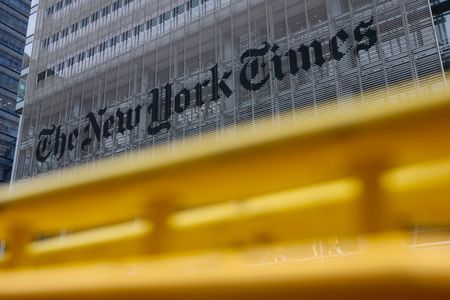
Nov 19 (Reuters) – A federal judge on Thursday said President Donald Trump’s defamation lawsuit against the New York Times and book publisher Penguin Random House may proceed, a victory for Trump in his legal campaign against media companies he accuses of treating him unfairly.
Trump has filed several lawsuits against media companies since 2024, alleging they defamed him or fraudulently misled the public with false coverage. His critics have denounced the lawsuits as attacks on the free press.
The lawsuit against the New York Times and Penguin Random House cited a book about Trump by two New York Times reporters and what it characterized as “false, malicious, defamatory, and disparaging” articles that he says were aimed at sabotaging his chances in the 2024 presidential election, which he won.
The Times and Penguin have denied defaming Trump and said in a court filing that his case is legally flawed and aimed at scoring political points.
Representatives for the New York Times, Penguin Random House and Trump’s personal lawyers did not immediately respond to requests for comment.
US District Judge Steven Merryday, an appointee of George H.W. Bush, handed down the ruling in federal court in Tampa, Florida.
Merryday threw out two of Trump’s claims but said the rest of his complaint plausibly alleged that statements accusing Trump of “planning and perpetrating complex crimes” were “based on incomplete, minimal information.”
The lawsuit against the Times and Penguin concerned two articles and a book that cast doubts on his origin story as a savvy businessman who ascended in the real estate and entertainment industries.
Trump cited 22 statements from the book by Times journalist Peter Baker titled “For Trump, a Lifetime of Scandals Heads Toward a Moment of Judgment” and 12 from the articles by Susanne Craig and Russ Buettner.
They include assertions about Trump’s role in creating his hit reality TV show “The Apprentice,” his inheritance from his father, his business ventures and upbringing in New York City.
The Times and Penguin said in a motion to dismiss that Trump’s lawsuit failed to explain how the statements were defamatory and included subjective opinions that cannot be proven true or false.
(Reporting by Luc Cohen in New York; Editing by Noeleen Walder)
Brought to you by www.srnnews.com