

Sept 23 (Reuters) – Mounting inflation pressures and a strengthening economy look to be pushing the Federal Reserve towards an interest-rate hike on the eve of critical national elections, with traders on Wednesday piling into bets on a second straight Fed rate increase in late October.
A closely watched measure of US business activity, S&P Global’s flash US Composite PMI Output Index, jumped this month to its highest level since July 2021, S&P Global reported on Wednesday. The survey’s measure of prices paid by businesses for inputs jumped to a nearly four-year high.
Oil prices took a leg up on Wednesday, with Brent crude futures rising about 2% to $101.09 a barrel, and diesel fuel prices have surged to over $6.50 a gallon, as the US-Iran war continues to disrupt supply. Diesel has particular potential to broaden price pressures, as it powers the equipment and trucks used to make and move goods throughout the economy.
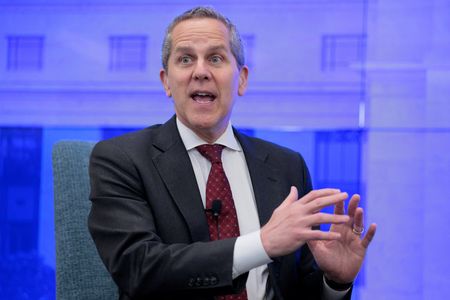
The backdrop of rising inflationary risks and a strong economy means the Fed is likely to deliver more rate hikes, Fed Governor Michael Barr said on Wednesday in what’s become a rare bit of “forward guidance” from a US central banker.
“Risks to achieving our inflation target have increased, while risks to the labor market have receded,” Barr told a Chicago Fed housing affordability conference. “In my base case, further policy adjustments are likely to be needed to ensure inflation comes down to target in a timely fashion.”
In a unanimous decision last week, Fed policymakers raised the central bank’s policy rate to the 3.75%-4.00% range, and 16 of 18 of them signaled the Fed would probably need to deliver at least one more rate hike before the end of this year. Barr’s remarks suggest he feels at least two more rate hikes will be required, though he did not say by when.
“In my view, given changes to the economy, we were out of position, and we made an adjustment in the right direction,” Barr said, referring to the quarter-percentage-point rate hike last week. “We want to support sustainable, durable growth in support of maximum employment, and price stability is crucial to that.”
Short-term US interest-rate futures contracts on Wednesday were pricing about a 70% chance of another Fed rate hike at the October 27-28 meeting, up from about 55% earlier in the day.
President Donald Trump’s Republicans are defending slim majorities in both houses of Congress in national elections on November 3, and back-to-back rate Fed rate hikes to fight inflation widely attributed to the administration’s policy decisions, including sharply higher tariffs and the war in Iran, could help Democrats.
Meanwhile affordability concerns for American would-be homeowners are on the frontburner again, after the Mortgage Bankers Association reported Wednesday that the average rate on a US 30-year fixed-rate mortgage rose to a more-than two-year high of 7.12% last week.
Trump has laid into the Fed – though not his hand-picked Fed chief Kevin Warsh – for what he calls a “political” decision to raise, not cut, rates, and has sought to address inflation concerns with a range of proposals, including ending the war in Iran after the elections, and banning exports of US diesel.
In an interview released Wednesday, Chicago Fed President Austan Goolsbee said the US central bank may need to treat the current energy shock as a source of persistent inflation rather than expect it to dissipate on its own, an approach that implies he also feels more rate hikes could be needed.
“For big negative supply shocks … you’d be better off just assuming from the beginning this thing is going to be pretty persistent on inflation: that’s certainly what happened in Covid; that’s what happened with the tariffs. That’s maybe what’s happening with oil,” Goolsbee said in a “Economics, Applied” podcast. “So we better be careful.”
(Reporting by Ann Saphir; Editing by Paul Simao and Andrea Ricci )
Brought to you by www.srnnews.com