


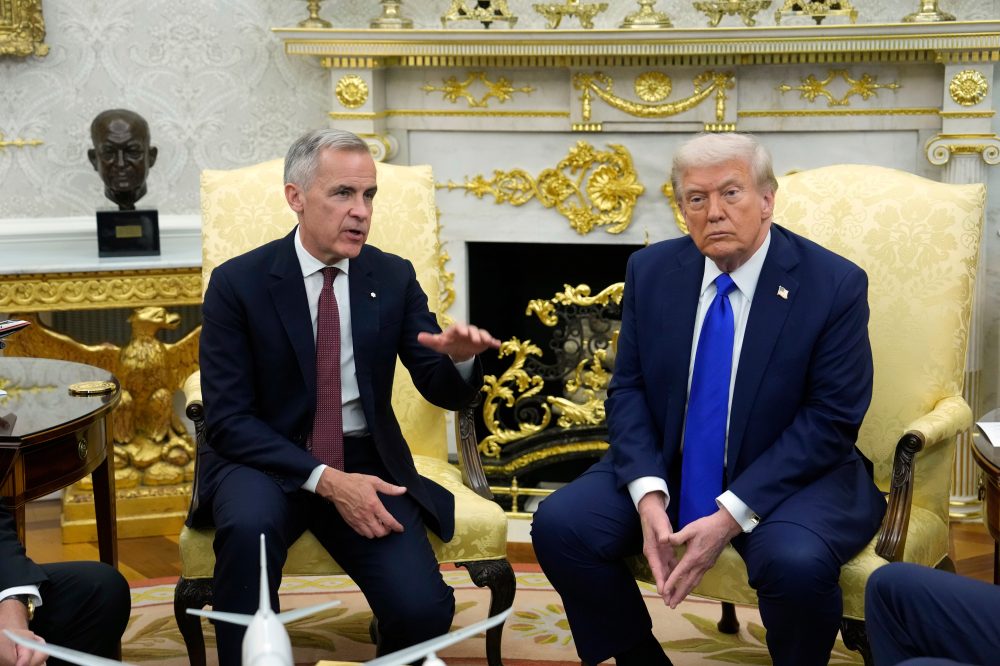
Relations between the U.S. and Canada could deteriorate further at 12:01 a.m. Wednesday if Trump goes ahead with his plan to impose 50% tariffs on $20 billion worth of Canadian products. The two countries are seeking a truce on the new taxes as the deadline approaches.
The fate of the Gaza ceasefire remains unclear after a marathon meeting Monday between U.S. negotiator Jared Kushner and Israeli Prime Minister Benjamin Netanyahu. Officials signaled moderate optimism but Israel offered no concrete commitment to the latest U.S.-proposed plan.
Trump’s decision to scale back joint military exercises with South Korea does not just slight a longtime ally – it raises broader concerns about the security interests of the United States in Asia and elsewhere. Trump explained his decision by citing South Korea’s refusal to join his war against Iran and pointing to what he said was his good relationship with North Korea’s reclusive dictator.
The Latest:
The deal that Trump signed at Versailles in June set an ambitious 60-day deadline for ending the war with Iran and reaching an accord on its nuclear program.
The deadline was Monday, and the two sides are further apart than they were then.
Talks, such as they are, have focused on reopening the Strait of Hormuz and lifting a U.S. blockade on Iran, both of which were supposed to have happened under the interim deal. There has been no sign of any compromise on the strait, or that detailed nuclear talks have even begun.
The U.S., meanwhile, has no good options for getting out of the war it started alongside Israel.
Acceding to Iran’s latest demands would mean giving it control over a critical international waterway that carried a fifth of the world’s traded oil and gas before the war – and would be tantamount to admitting defeat. Escalating the deeply unpopular war would further draw down U.S. supplies of advanced missile interceptors, jolt the world economy, and drive up gas prices ahead of U.S. congressional elections.
So both sides have dug in, hoping the other will blink first. So far, neither has.
▶ Read more
Trump on Sunday ordered the U.S. military to downsize the 11-day Ulchi Freedom Shield exercises, which began Monday as scheduled. It wasn’t known which parts of the training were being scaled back.
His announcement baffled many in South Korea, which has been closely allied with the U.S. for decades and where national security is a top priority due to threats from nuclear-armed North Korea.
Trump explained his decision by citing South Korea’s refusal to join his war against Iran and pointing to what he said was his good relationship with North Korea’s reclusive dictator, a transactional and personal approach to foreign policy that has defined the Republican’s presidency.
“There is no American interest that I can see in this,” said Dan Fried, an assistant secretary of state for European affairs in the George W. Bush administration. “On all levels it makes no sense. It undermines the South Koreans, undermines the Japanese, frightens the Taiwanese, unnerves NATO and emboldens the Chinese, not to mention the North Koreans.”
▶ Read more
A marathon meeting Monday between U.S. negotiator Jared Kushner and Israeli Prime Minister Benjamin Netanyahu left the fate of the Gaza ceasefire unclear, with officials signaling moderate optimism but offering no concrete commitment by Israel to the latest U.S.-proposed plan.
Hamas has already agreed to the proposal. American negotiators appeared to acquiesce to Israeli demands that Hamas disarmament must come before any reconstruction of the devastated Palestinian enclave. They did not publicly signal that Israel had made any commitments to withdraw from the 60% of Gaza that Israeli troops currently occupy.
That’s a major sticking point in the plan and one that Hamas had pressed negotiators to compel Israel to fulfill prior to the meeting. The talks came days after Netanyahu rejected the 15-point, U.S.-backed road map to move the ceasefire deal forward, saying there would be no withdrawal without disarmament.
A day earlier, Kushner met for two hours with Hamas’ leader in Egypt.
▶ Read more
The United States and Canada have wrangled for decades over trade, poking each other interminably over sore spots like Canadian softwood lumber imports and U.S. access to Canada’s protected dairy market.
President Donald Trump’s belligerent approach to dealing with Canada marks an extraordinary departure from the traditionally cooperative relationship between the two countries. Trump has hit Canadian goods with tariffs – in a push to bring manufacturing back to the United States – and has repeatedly made inflammatory comments about turning Canada into America’s 51st state.
Tension could hit new heights at 12:01 a.m. Wednesday if Trump goes ahead with his plan to impose 50% tariffs on $20 billion worth of Canadian products, ranging from hockey sticks to tongue depressors.
As the deadline approaches, the two countries are seeking a truce that would avoid the new round of tariffs.
″We are negotiating,” Canadian Prime Minister Mark Carney told reporters Monday, speaking in French. “The negotiations are very intense and delicate. This is not the time to talk about negotiations in public.”
▶ Read more
Brought to you by www.srnnews.com