



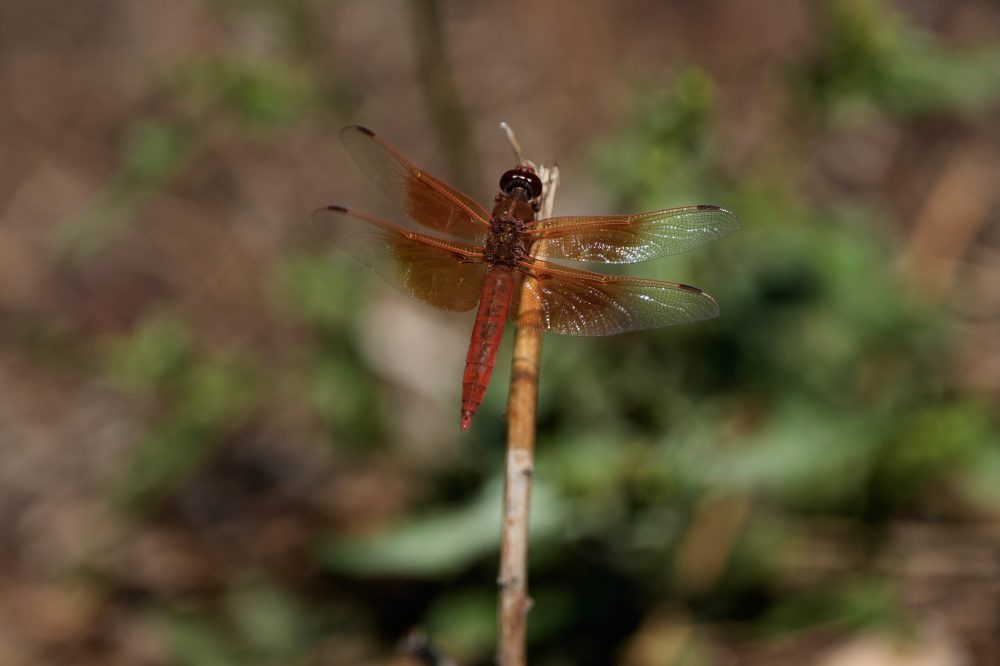
SAN FRANCISCO (AP) – Californians are spotting swarms of dragonflies flitting around parks, chasing mosquitoes in ponds and hunting flies on farms, a phenomenon experts say was likely fueled by unusually warm spring rains.
Peter Veilleux, who owns a nursery in Oakland, said he started noticing the dragonflies – at one point spotting about 100 flying together – while walking his dog at a park near his house and around the city’s Lake Merritt.
“It’s been amazing to see them,” Veilleux said, adding that he started seeing big groups of dragonflies in July.
He was so awed by the sight that he posted about it on Facebook, asking if anyone else was seeing the formidable predators in such large numbers. Dozens of people commented about their own sightings in the San Francisco Bay Area and elsewhere in California.
It is common to see dragonflies during the summer months, when they emerge from freshwater as flying insects. But this year’s large numbers are probably due to the warm monsoon storms that came through the state in late spring and early summer, said Kathy Biggs, a dragonfly expert and co-author of the book “Dragonflies of California.”
She said most are likely wandering gliders, a highly migratory dragonfly that can appear in large numbers when conditions line up. Dragonflies, which can fly at speeds of up to 35 mph (56 kph), use air pressure changes to help them fly great distances, Biggs said.
“We could say that they’re surfing the pressure system, the monsoon,” she added.
Joe Del Bosque said he noticed swarms of them earlier this month at his farm in Fresno County, flying 10 to 20 feet (3 to 6 meters) above him.
“We do have them every year, but we had more than normal,” he said.
Del Bosque said he was happy to see the flying hunters because they eat aphids, whiteflies and fruit flies that feed on his crops. The insects, along with ladybugs working on the plants, are excellent pest control because they eat tiny insects on the plants and larger winged ones, like adult aphids and moths, he said.
“They are like little fighter jets,” Del Bosque said. “They zoom in for other insects and capture them in the air.”
Dragonflies spend most of their lives wingless and underwater. Their life cycle begins after female and male dragonflies mate and the female dragonfly lays tiny eggs in freshwater. After the eggs hatch, the young dragonflies, called nymphs, live underwater for at least six months and for up to five years for some species. They start hunting then and feed on mosquito larvae, tadpoles, and even other nymphs.
Once they emerge from the water, they shed their skin and transform into four-winged insects that can move their forewings and hindwings independently. This allows them to fly forward, backward, up and down, and hover perfectly in place.
But their life as flying animals is short, lasting a few weeks or months. They spend it looking for new lakes, rivers and ponds, preying on tiny insects and attempting to repeat the cycle of life.
“They’re super agile, super strong flying insects with really good vision, really good eyes, and really strong flight muscles, and they are voracious predators that are out there feeding on mosquitoes nonstop,” said Chris Grinter, senior collection manager of entomology at the California Academy of Science in San Francisco.
Grinter said dragonflies are among the most effective predators in nature, with more than 90% of their hunts ending successfully.
“They can eat hundreds of mosquitoes a single day,” he said.
Dragonflies have awed humans for thousands of years. To Native Americans, a dragonfly is a symbol of purity and happiness. In Japan, they symbolize power, agility and victory. In some European folklore, they were considered to represent evil or bad luck.
To attract them to your garden, Biggs recommends avoiding pesticides and building fishless ponds and sunny areas with perches.
There are about 70 dragonfly species in California, but most are not migratory and remain near where they emerged, Biggs said.
Some of them might be out the very first thing in the spring, even as the snow is melting, and some of them are out in the Mojave Desert in the driest, hottest places in California, Grinter said.
Biggs said the migratory species keep moving on, ‘surfing’ high-pressure systems in the air.
“They could be somewhere a few days and then leave,” she said.
Brought to you by www.srnnews.com